If you’ve ever cut open a vanilla bean and scraped those tiny dark seeds into a batch of crème brûlée or buttercream, you know the payoff: little flecks of real vanilla speckling the finished product, proof to anyone looking that you used the real thing. Vanilla bean paste — a thick, syrupy mixture that combines pure vanilla extract with ground vanilla bean seeds and sometimes a small amount of thickener like sugar or gum — gives you that same visual and flavor result without having to split and scrape individual pods. One teaspoon of paste substitutes cleanly for one teaspoon of pure vanilla extract in most recipes, with the bonus of those signature specks. For small-batch bakers making a dozen cookies, retail jars work just fine. But for high-volume operations — small bakeries, wedding cake studios, professional confectioners — buying paste at retail prices is quietly bleeding margin. This guide is for you: how to evaluate bulk paste pricing, run the cost-per-ounce math correctly, and decide when paste actually makes economic sense versus extract or whole beans.
| EDITOR'S PICK[Nielsen-Massey Pure Vanilla Bea…](https://www.amazon.com/dp/B0FMKKZ4YM?tag=greenflower20-20) | Mid-tier[Vanilla Bean Paste for Baking a…](https://www.amazon.com/dp/B08BJFCP1L?tag=greenflower20-20) | Budget pick[OliveNation Madagascar Vanilla…](https://www.amazon.com/dp/B078SH3D6H?tag=greenflower20-20) | |
|---|---|---|---|
| Origin | — | Madagascar | Madagascar |
| Net Weight | 32 Fl Oz | 32 Fl Oz | — |
| Texture | — | — | Thick |
| Vanilla Seeds | — | Real | With Seeds |
| Pack Size | 1 | 1 | — |
| Price | $101.50 | $74.99 | $48.99 |
| See on Amazon → | See on Amazon → | See on Amazon → |
Why Paste Costs More Than Extract (And Why That’s Not the Whole Story)
Before running any numbers, it helps to understand why vanilla bean paste commands a premium over pure extract in the first place — because the answer affects how you interpret bulk pricing.
Pure vanilla extract is made by macerating vanilla beans in an alcohol-and-water solution. The USDA standard of identity (referenced in Nielsen-Massey Vanillas’ product specification sheets) requires a minimum of 13.35 ounces of vanilla beans per gallon of finished extract at 35% alcohol. That’s the floor. The beans are extracted, then removed — you get flavor compounds in solution, but no physical bean material in the bottle.
Paste includes all of that, plus the actual seed caviar and often ground bean powder or a concentrated vanilla extractive. You’re paying for more vanilla material per ounce of finished product. Fine Cooking’s overview of vanilla paste versus extract notes that the paste format delivers a noticeably more complex, rounded vanilla flavor in applications where the liquid volume of extract matters — custards, pastry creams, ganache — because you get higher solids content without adding extra liquid.
That complexity has a real cost. Retail paste typically runs $1.50–$3.00 per ounce depending on brand and origin. Nielsen-Massey’s 32-ounce paste jar, which is the standard entry point for serious home bakers and small-production professionals, typically retails in the $55–$75 range as of May 2026, depending on the retailer. That’s $1.72–$2.34 per ounce. Heilala’s paste products, sourced from Tonga, run higher — often $2.80–$3.50 per ounce at retail because of their single-origin positioning and smaller production scale.
The bulk price break is real, but it only materializes at meaningful volume thresholds. Here’s where many high-volume bakers miscalculate: they assume that any “professional” or “bulk” packaging is automatically cheaper per ounce. It often is — but not always, and the variable-quality landscape of paste makes direct price comparison without label scrutiny a mistake.
Running the Cost-Per-Ounce Math: A Practical Framework
The math itself is straightforward. The judgment calls around it are where things get interesting.
By the numbers — sample paste pricing landscape, May 2026:
| Format | Typical Size | Approx. Price Range | Cost Per Ounce |
|---|---|---|---|
| Nielsen-Massey paste, retail jar | 32 oz | $55–$75 | $1.72–$2.34 |
| OliveNation professional paste | 1 lb (16 oz) | $28–$38 | $1.75–$2.38 |
| Spice Jungle bulk paste | 5 lb (80 oz) | $95–$130 | $1.19–$1.63 |
| Generic “professional grade” paste | 1 gallon (~128 oz) | $85–$120 | $0.66–$0.94 |
That gallon-format number looks compelling — and it may be. But the word “professional grade” on a bulk paste label doesn’t carry the same regulatory weight as “pure” on an extract label. This is where label literacy saves you from a bad bulk buy.
What to Check on a Bulk Paste Label
Before ordering anything at gallon scale, look for these specifics:
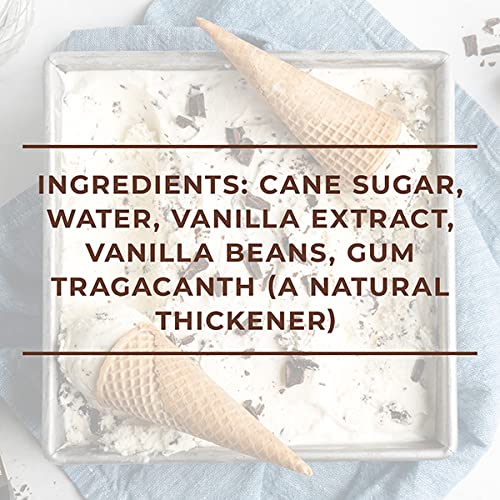
Vanilla extractive content. Quality paste should list “pure vanilla extract” or “vanilla bean extractive” as a primary ingredient, not “artificial vanilla flavor” or “vanillin.” If vanillin (a synthetic compound that mimics vanilla’s primary flavor molecule) appears before real extractive on the ingredient list, you’re buying a flavored paste, not a pure vanilla paste. Serious Eats’ deep dive on vanilla extract — one of the most cited evaluations among baking professionals — draws this distinction clearly: vanillin-forward products taste sharper and one-dimensional compared to complex multi-compound pure vanilla.
Bean content by weight. Premium bulk pastes from suppliers like OliveNation and Spice Jungle publish the vanilla bean content in their product specifications. A well-formulated paste should contain at least 100–150 grams of vanilla beans per kilogram of paste, which is roughly equivalent to the standard of identity for pure extract. Anything substantially below that is being stretched with thickeners and flavoring to simulate richness.
Origin declaration. Bulk paste made from Madagascar Bourbon vanilla (the dominant variety, characterized by a rich, creamy, familiar vanilla profile) will behave differently in formulation than Tahitian-origin paste (more floral and fruity, with a lighter top note that can recede in high-heat applications like baked custards). King Arthur Baking Company’s vanilla paste usage guide specifically flags this: Tahitian varieties perform best in cold or lightly heated applications — pastry creams, frostings, ice cream bases — where the volatile floral notes won’t cook off.
When Bulk Paste Makes Economic Sense (And When It Doesn’t)
Running the numbers correctly requires mapping your actual usage against the format options. Here are the three decision scenarios that come up most often for high-volume bakers.
Scenario 1: High-Volume, Consistent Application
If you’re running paste through a standard recipe at consistent weekly volumes — say, a signature vanilla buttercream that goes on every layer cake you sell — bulk paste at the 5-lb or gallon scale is almost always the right call, provided the quality threshold is met. At $1.19–$1.63 per ounce for a reputable 5-lb bulk paste versus $1.72–$2.34 for retail jars, you’re saving 25–40% per ounce. On 10 ounces per week across 52 weeks, that’s $260–$620 saved annually on a single recipe component.
The caveat: paste has a shorter effective shelf life than pure extract. Pure vanilla extract, which is high-alcohol by definition, is shelf-stable essentially indefinitely. Paste, because it contains vanilla bean solids and sometimes a small amount of sugar or glycerin as a carrier, has a typical recommended shelf life of 2–3 years from production, and quality reviewers on professional baking forums consistently note that paste opens to air degradation faster than extract after the container is opened. OliveNation’s product listings recommend storing opened bulk paste in a cool, dark location and using within 12–18 months of opening. If your weekly usage is low enough that a gallon container would sit open for 18+ months, downsize the format.
Scenario 2: Showpiece or Specialty Applications
For high-visibility applications — wedding cake fillings, plated dessert components, anything where vanilla is a lead flavor rather than a background note — the economics shift. This is where origin-specific paste earns its premium, and where buying the cheapest available bulk product can cost you customer perception.
Pastry professionals sourcing for these applications should look at single-origin bulk options. Nielsen-Massey offers professional foodservice quantities of their Madagascar Bourbon paste through select distributors, and their published spec sheets confirm consistent fold levels (a measure of vanilla’s concentration — a “twofold” extract is twice as concentrated as single-fold) across production batches. Consistency is worth paying for when you’re scaling a recipe for 200 servings.
For cold-application showpieces specifically — think vanilla namelaka, cold-set panna cotta, or fresh cream fillings — this is also where Tahitian paste’s floral complexity genuinely outperforms Bourbon-type on flavor. The Fine Cooking overview of vanilla varieties confirms this pattern: Tahitian vanilla’s pronounced cherry-like and anise-adjacent notes come forward most clearly in uncooked or barely-heated applications. If you’re building a signature dessert around vanilla as the star, spending $2.50–$3.00 per ounce on origin-specific paste is defensible as a cost of goods.
Scenario 3: Mixed-Use Kitchens
Many small-batch bakeries and pastry operations run both everyday production (where cost efficiency matters) and custom/specialty work (where ingredient quality signals something to clients). The practical solution that works for many operators, per aggregated professional baking community discussions, is a two-tier system: a 5-lb bulk paste for standard production recipes, and a retail or small-professional jar of single-origin paste for premium applications. The blended cost across your total paste spend will be meaningfully lower than buying retail for everything, without sacrificing quality on the work that justifies a premium.
Supplier Landscape and Where to Actually Buy
For paste specifically — rather than extract — the supplier options narrow somewhat compared to extract sourcing.
OliveNation carries a professional vanilla bean paste line in 1-lb and 5-lb formats with clear ingredient transparency. Their product listings as of 2026 specify Madagascar origin and list vanilla bean extractive content. Well-regarded among small bakery operators for reliable order fulfillment.
Spice Jungle offers competitive bulk paste pricing at the 5-lb scale and publishes detailed spec information. Particularly useful if you’re already ordering other bulk spice components, since combined shipping reduces landed cost per ounce.
Nielsen-Massey sells professional/foodservice quantities through authorized distributors rather than direct-to-consumer in bulk. Their product specification sheets are among the most transparent in the industry regarding extractive content and fold levels — worth requesting if you’re evaluating a supplier claim.
For Singing Dog Vanilla and Beanilla, both carry paste in formats that bridge serious home baker and small-pro use — typically 4–8 oz retail through 1-lb professional — and both are transparent about origin. They won’t beat bulk pricing, but they’re strong quality benchmarks for comparison.
The Decision Rule
If your operation uses more than two pounds of vanilla bean paste per month, the 5-lb bulk format from a transparent, origin-declared supplier will deliver material cost savings without meaningful quality compromise — assuming you verify fold content and bean-material percentage on the spec sheet before ordering.
If you use less than that, or if vanilla paste features in your highest-margin showpiece work, prioritize origin and consistency over unit price. The cost difference between retail and small-professional formats at that volume is real but manageable; the difference between a flat, one-dimensional paste and a complex, well-sourced one is something your customers will notice even if they can’t name it.
Buy for the application. Run the ounce math before committing to gallon formats. And read the label before you trust the price.