If you’ve ever sliced a vanilla bean down the middle and scraped out those tiny black seeds — those little specks that signal “real vanilla” to anyone eating your dessert — you already understand the appeal of vanilla bean paste. Paste is essentially a thick, spoonable concentrate that delivers both the flavor of pure vanilla extract and those visual seeds, all in one product. No pod-splitting, no sticky knives, no $8-per-bean math. You measure it like extract (typically a 1:1 swap) and get the showstopper look of a scratch-made vanilla custard or buttercream. That said, not every jar on the market performs the same way. Formulations vary in thickness, bean origin, sweetener base, and vanilla concentration — differences that matter enormously when you’re scaling a recipe for a wedding cake order or dialing in a panna cotta that has to be perfect. This article breaks down four major players — Nielsen-Massey, LorAnn, Taylor and Colledge, and private-label bulk options — with clear tradeoffs so you can make the right call for your specific context.
What Makes One Paste Different From Another?
Before the brand breakdown, a quick orientation on the variables that actually drive performance differences.
Vanilla extract base: Most pastes start with a pure vanilla extract — typically a 2-fold concentrate — as the liquid component. The quality of that underlying extract (bean origin, extraction method, alcohol/glycerin ratio) defines the base flavor before anything else matters.
Thickening agents: Paste gets its body from a binder. Common options are sugar syrup, glucose syrup, guar gum, or xanthan gum. This is where formulations diverge most visibly. A sugar-syrup base produces a thick, honey-like consistency; a gum-thickened formula can range from pourable to gel-like. The binder also affects how the paste behaves under heat and whether it contributes measurable sweetness to your formula.
Bean-to-paste ratio: The concentration of ground vanilla bean specks (technically vanilla bean caviar plus ground pod fragments) varies by brand. Higher ratios mean more visual impact and aromatic complexity; lower ratios mean the paste leans harder on the extract base for flavor.
Origin: “Madagascar Bourbon” is the most common designation — “Bourbon” here refers not to whiskey but to the Bourbon Island (now Réunion), where this vanilla variety originated before plants were transplanted to Madagascar. Single-origin pastes — Tahitian, Tongan, or Indonesian — carry distinct flavor profiles: Tahitian skews floral and cherry-forward; Indonesian is smokier and earthier.
King Arthur Baking Company, in their guide “Vanilla Bean Paste: What It Is and How to Use It,” notes that the paste format is especially valuable when visual presentation matters, citing custards, ice creams, and buttercreams as the highest-payoff applications. Fine Cooking, in “Understanding Vanilla: Extract, Paste, Powder, and Beans,” reinforces that paste’s flavor delivery is comparable to a same-quality extract, meaning the visual upgrade is the primary reason to choose it — flavor parity depends entirely on matching the underlying extract quality to what you’d otherwise use.
The Brand Breakdown
Nielsen-Massey Vanilla Bean Paste
Nielsen-Massey is the reference standard most buyers compare everything else against, and for good reason. The formulation uses the brand’s own Madagascar Bourbon pure vanilla extract as the base, combined with sugar, ground vanilla beans, and natural gum. The result is thick, glossy, and reliably uniform jar to jar.
The commercial value of this paste goes beyond flavor. When your finished product signals ingredient quality before someone takes a bite — those visible specks in a buttercream or custard — the paste earns its price delta over extract. Small-batch bakery owners and pastry professionals consistently cite Nielsen-Massey by name as a trust signal with customers, which is a commercial-grade observation, not just a flavor preference.
Texture: Consistently thick across production batches. No surprise “it’s more liquid than I expected” complaints — what you see in product photos is what arrives.
Flavor profile: Classic deep Madagascar Bourbon vanilla — brown sugar, warm wood, slight tobacco finish. Well-rounded and high-impact.
Best for: Pastry professionals, small-batch bakery owners, anyone whose finished product is the sales pitch. The 4 oz jar hits a practical size for regular bakery use; larger formats make sense when you’re deploying it weekly.
Tradeoff: Premium pricing. Per-ounce cost is meaningfully higher than LorAnn or store-brand options. If you’re using paste purely for flavor (not visual effect) in a high-heat application where specks cook out, a quality extract may deliver comparable results at lower cost.
Nielsen-Massey
$101.50
In stock on Amazon
Check price on AmazonLorAnn Vanilla Bean Paste
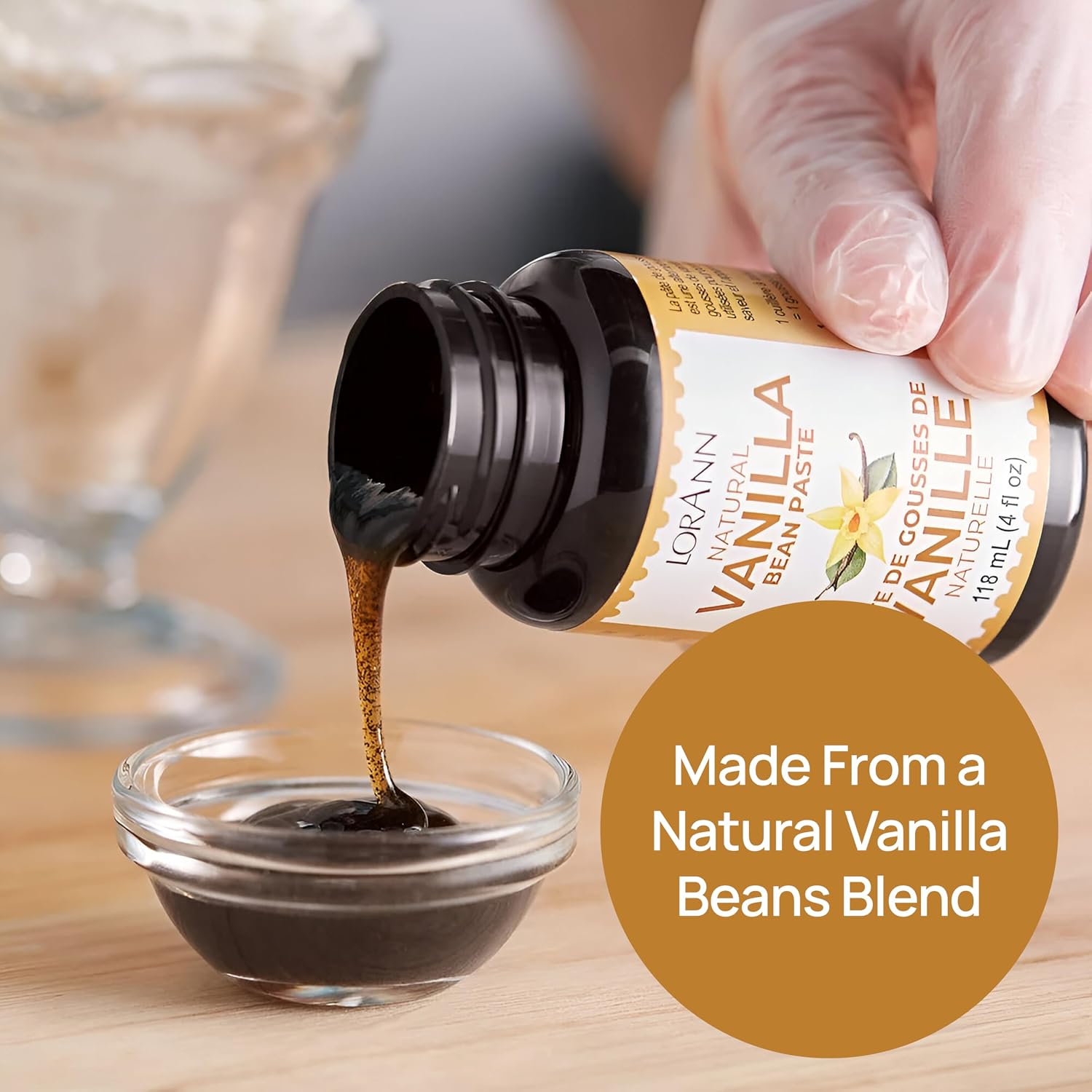
LorAnn is well-known in the home baker and candy-maker space, and its vanilla bean paste is widely available through craft and baking supply retailers. The price point is notably more accessible than Nielsen-Massey, which makes it appealing for high-volume applications or budget-conscious buyers building their first bottle.
However, there is a product-specific texture characteristic worth knowing before you buy: the consistency is thinner than many buyers expect. For applications where the paste needs to hold visual suspension in a cold preparation or sit on top of a custard without bleeding, this formulation difference from the Nielsen-Massey standard is real and relevant.
Texture: More pourable than paste-like. Plan accordingly in recipes where viscosity matters.
Flavor profile: Solid vanilla flavor, functional for most baked applications, though the base extract does not carry the same complexity tier as Nielsen-Massey’s Madagascar Bourbon foundation.
Best for: Volume applications where you need paste’s visual marker on a budget, or baked applications where specks will be distributed through batter and viscosity does not matter. A good entry point for bakers transitioning from extract to paste format.
Tradeoff: Thinner consistency surprises buyers expecting a Nielsen-Massey-like body. If you’re using it in a custard, buttercream, or any preparation where texture matters, adjust expectations or technique before your first production batch.
LorAnn
$14.32
In stock on Amazon
Check price on AmazonTaylor and Colledge Vanilla Bean Paste
Taylor and Colledge operates from a distinct format: a squeezable tube rather than a jar. That sounds like a minor packaging difference, but it earns genuine loyalty for one specific reason — the elimination of alcohol taste as the product’s defining advantage.
Most vanilla extracts use alcohol (typically at 35% or higher per U.S. FDA standards for pure vanilla extract) as the extraction solvent and preservative. In uncooked or low-heat applications, that alcohol can leave a noticeable nose. Taylor and Colledge’s formulation uses a glycerin base rather than an alcohol-forward one, which allows bakers to sidestep that alcohol note across all vanilla applications — including icings, no-bake fillings, and drinks. The Kitchn, in their overview “What Is Vanilla Bean Paste? Here’s What You Need to Know,” notes that glycerin-based pastes are specifically worth considering when alcohol taste is a concern, making Taylor and Colledge’s positioning well-aligned with that guidance.
Texture: Thick, pipeable, tube-dispensed — practical for small quantities and controlled portioning.
Flavor profile: Softer, less alcohol-forward. Vanilla flavor is clean and pleasant; the glycerin base reads slightly differently than an alcohol-extract base to a trained palate, but for most applications it’s indistinguishable in a positive way.
Best for: No-bake applications, raw doughs, Swiss or Italian meringue buttercreams, and any preparation where alcohol off-notes have been a problem. Particularly useful for non-alcohol formulations, whether for halal compliance or personal preference.
Tradeoff: Tube format means no bulk option. If you’re scaling, you’ll be going through tubes quickly, which is less economical per ounce at high volume than jar-format competitors.
Nielsen-Massey
$23.17
In stock on Amazon
Check price on AmazonBulk and Private-Label Paste: The 128 oz Calculation
For small-batch bakery owners and high-volume pastry professionals, gallon-format paste is the obvious cost lever. The per-ounce math can be compelling — sometimes 40–60% lower than retail jar pricing when sourced through professional baking supply channels.
But a significant risk factor in bulk purchasing deserves direct attention: temperature-related off-notes from plastic packaging. Many bulk pastes ship in food-grade HDPE (high-density polyethylene) plastic containers. HDPE is safe at normal temperatures, but repeated exposure to heat — a warehouse summer, a delivery truck in August, storage in a non-climate-controlled facility — can cause the container to transfer trace notes into the contents. Vanilla paste, being thick and rich in suspended aromatic compounds, is more susceptible to absorbing these notes than a water-based liquid would be.
Serious Eats, in their roundup “The Best Vanilla Extracts, Tested and Reviewed,” recommends glass packaging for long-term vanilla storage as a baseline, noting that extract manufacturers who maintain glass for their standard products do so for exactly this reason. That logic extends to paste storage at any volume.
What this means for buyers: If you’re sourcing bulk paste, ask your supplier explicitly about cold-chain handling and storage conditions before purchase. Inspect immediately on receipt — if there’s any chemical or off-note on opening, the product has been compromised. Repack into smaller glass containers immediately after opening and store in a cool, dark environment. Do not store bulk vanilla paste in a warm back-of-house environment.
Approximate cost comparison (per fluid ounce, 2026 market pricing)
| Format | Approx. $/oz | Tier |
|---|---|---|
| Nielsen-Massey 4 oz jar | $4.25–$6.00 | Nielsen-Massey — $101.50 |
| Taylor and Colledge 65g tube | $3.50–$5.00 | Nielsen-Massey — $23.17 |
| LorAnn 4 oz jar | $2.00–$3.00 | LorAnn — $14.32 |
| Bulk private-label gallon (128 oz) | $0.75–$1.50 | LorAnn — $14.32 |
Pricing reflects aggregated retail and professional supply channel data as of Q2 2026. Significant variance by vendor.
LorAnn
$14.32
In stock on Amazon
Check price on AmazonFrequently Asked Questions
Can I substitute vanilla bean paste 1:1 for vanilla extract in any recipe? Yes, as a starting point. King Arthur Baking Company’s guide “Vanilla Bean Paste: What It Is and How to Use It” confirms the 1:1 swap by volume as the standard rule: one teaspoon of paste replaces one teaspoon of extract. The only exception worth noting is in very delicate liquid preparations (like a thin glaze), where paste’s viscosity and any sugar content may require minor adjustment.
Why does vanilla bean paste cost so much more than extract per ounce? Two reasons: the physical beans and the production process. Paste contains actual ground vanilla beans — not just the extracted flavor compounds — which adds material cost. It also requires a blending and quality-control step beyond simple extraction. Fine Cooking, in “Understanding Vanilla: Extract, Paste, Powder, and Beans,” notes that the visual premium — the bean specks — is, in part, what you’re paying for.
Does the paste actually taste noticeably different from a high-quality pure extract in a baked cookie or cake? In a baked application with significant heat, the flavor difference is minimal compared to a same-quality pure extract. The visual difference — those specks — remains even after baking, which is the real payoff. In cold or no-bake applications, paste’s more complex aroma is more perceptible.
How should I store a large jar of vanilla bean paste, and how long does it keep? Cool, dark, airtight storage is essential. Most commercial pastes have a stated shelf life of 2–4 years unopened, 1–2 years after opening. For bulk formats especially, avoid temperature fluctuations and repack into glass if you’re opening a large plastic container. Refrigeration is not required but will not hurt.
Is the sugar content in some vanilla bean pastes a problem for precise pastry recipes? It can be at scale. Many pastes use a sugar or glucose syrup as their thickening base, which means they contribute measurable sweetness. For most home recipes, this is negligible. For professional pastry applications where sugar ratios are precision-critical — French macarons, tempering chocolate ganache — factor in the sweetener contribution if you’re using paste at higher-than-standard volumes. Check the ingredient label: if “sugar” or “glucose syrup” appears before “vanilla extract,” the sweetener content is significant.
What does “Madagascar Bourbon blend” mean on a vanilla paste label versus a single-origin paste? “Madagascar Bourbon” is a variety designation — it refers to vanilla planifolia beans grown in Madagascar, historically associated with the Bourbon Islands. “Blend” means the paste uses beans or extract from multiple crop years or sub-regions within Madagascar, which stabilizes flavor year to year. A single-origin paste specifies a single farm, region, or country — Tonga, Tahiti, Papua New Guinea — offering a more distinctive and traceable flavor profile, typically at a higher price.
The Decision Rule
If you’re running a professional or semi-professional context where visible bean specks signal ingredient quality to your customer, Nielsen-Massey is the reference purchase — the texture is reliable, the flavor is consistently excellent, and pastry professionals cite it by name as a trust signal. Nielsen-Massey — $101.50
If you need paste primarily for flavor parity with your current extract at a lower cost, LorAnn gets you there — just expect thinner consistency and plan your technique accordingly. LorAnn — $14.32
If alcohol off-notes have been a problem in your no-bake or uncooked applications, Taylor and Colledge’s tube format solves that specific problem better than anything else in this comparison. Nielsen-Massey — $23.17
If you’re buying bulk, the per-ounce math is compelling — but cold-chain handling and storage conditions are non-negotiable. Verify before you commit to a gallon, and have a glass repacking plan ready on receipt. A plastic off-note in a bulk gallon can ruin an entire production batch. The savings evaporate fast when you have to discard product. LorAnn — $14.32