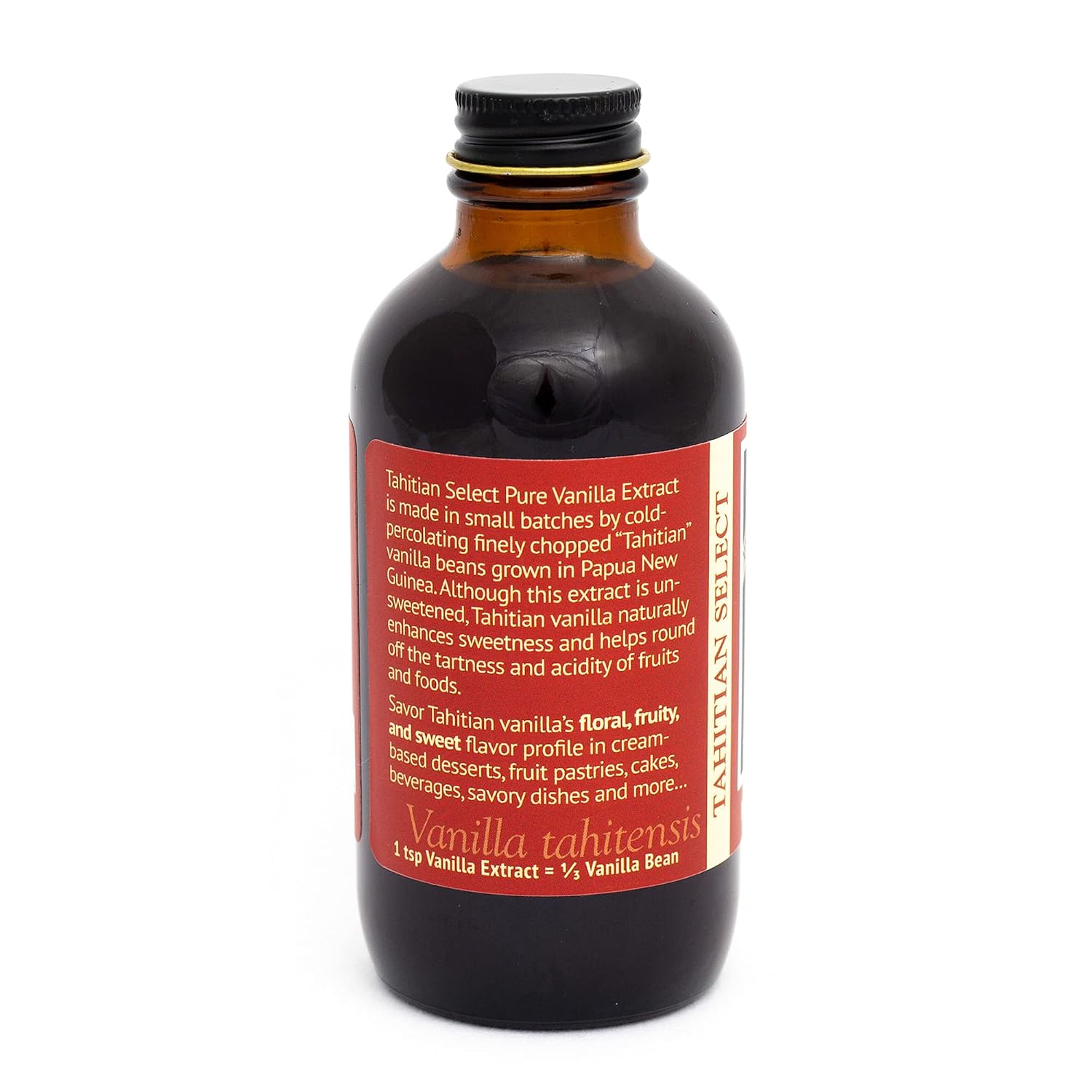
If you’ve stood in the baking aisle — or more likely scrolled through an extract supplier’s website — and noticed a bottle labeled “Tahitian vanilla” sitting next to the standard Madagascar variety, you might have wondered whether it’s a marketing gimmick or a genuine upgrade. The short answer: it’s genuinely different, but “different” doesn’t mean “better for everything.” Vanilla extract, at its most basic, is the flavor compound vanillin — the aromatic molecule responsible for that warm, familiar sweetness — dissolved in alcohol and drawn from cured vanilla beans. Madagascar Bourbon vanilla (named for the island of Réunion, historically called Bourbon, not the whiskey) is the workhorse of the baking world: rich, creamy, and boldly sweet. Tahitian vanilla, grown primarily in Papua New Guinea and French Polynesia, comes from a different species of vanilla orchid entirely, Vanilla tahitensis, and it produces a profile that’s lighter, more floral, and more fruity — with notes that bakers and pastry chefs often describe as cherry-like, anise-adjacent, or reminiscent of heliotrope. This article will walk you through exactly where that difference comes from, where it works in your favor, and — just as importantly — where it doesn’t.
| EDITOR'S PICK[Nielsen-Massey Madagascar Bourb…](https://www.amazon.com/dp/B000GAWH4G?tag=greenflower20-20) | Mid-tier[Tahitian Gold - Pure Vanilla Ex…](https://www.amazon.com/dp/B096X4K534?tag=greenflower20-20) | Budget pick[BRBON 4oz Pure Vanilla Extract…](https://www.amazon.com/dp/B0DTB3KZQM?tag=greenflower20-20) | |
|---|---|---|---|
| Size | 8 oz | 4 oz | 4 oz |
| Origin | Madagascar | Papua New Guinea | Madagascar |
| Non-GMO | — | — | ✓ |
| Gluten-Free | — | — | ✓ |
| Vegan/Kosher | — | — | ✓ |
| Price | $34.14 | $15.00 | $14.94 |
| See on Amazon → | See on Amazon → | See on Amazon → |
What Makes Tahitian Vanilla Chemically Different
The difference between Tahitian and Madagascar Bourbon vanilla isn’t just terroir (the French word for the way climate and soil influence a crop’s flavor — think of why a strawberry from your backyard tastes different from a supermarket one). It goes deeper than that, into the genetics of the plant itself.
Vanilla planifolia, the species used for Madagascar Bourbon beans, cures into a flavor profile dominated by vanillin — that clean, straightforward vanilla hit you know from a good birthday cake. Vanilla tahitensis produces significantly less vanillin relative to a compound called heliotropin (also known as piperonal), along with higher concentrations of anisyl compounds and certain aromatic esters (fragrant molecules that form when acids and alcohols combine during the curing process). Serious Eats, in Stella Parks’s overview of vanilla bean varieties, notes that Tahitian beans tend to register as more perfume-like and less “baked-good” than their Madagascar counterparts — which is a crucial distinction once you start thinking about where heat enters the equation.
Here’s why that matters in a practical baking context: vanillin is relatively heat-stable; many of Tahitian vanilla’s signature aromatic compounds are not. When you bake a cookie at 350°F for 12 minutes, a meaningful portion of what makes Tahitian vanilla distinctive — those floral, fruity top notes — volatilizes out of the batter before it ever reaches your mouth. What you’re left with is a gentler, slightly thinner vanilla flavor than you’d get from a Madagascar extract at the same dose. This is not a flaw in the extract. It’s a characteristic that tells you exactly when to use it and when to step aside.
Nielsen-Massey’s technical documentation on their Tahitian variety specifically flags this behavior, recommending Tahitian extract for “no-bake and low-heat applications” where the floral aromatic compounds can survive long enough to express themselves in the finished dish.
Where Tahitian Vanilla Actually Shines: A Decision Framework
Rather than thinking of Tahitian vanilla as a premium upgrade to reach for by default, think of it as a specialist. It earns its place in specific applications, and in those applications it genuinely outperforms Madagascar.
No-bake and cold applications are where Tahitian vanilla is essentially unbeatable. Pastry cream (a cooked custard used to fill éclairs and tarts, made by tempering hot milk into egg yolks and sugar), buttercream, mousse, no-churn ice cream, and cold-set cheesecakes are all ideal candidates. In these contexts, nothing is burning off the aromatics. What’s in the bottle ends up in the bowl — and what’s in the bowl is floral, complex, and noticeably different from the standard vanilla flavor your customer or guest has tasted a hundred times before.
White chocolate applications are a particularly strong match. King Arthur Baking’s ingredient guide on vanilla notes that delicately flavored bases benefit from extracts with lighter profiles, because a robust Madagascar extract can actually crowd out the nuances of high-quality white chocolate. Tahitian vanilla’s floral quality reads as complementary rather than competitive.
Fresh fruit desserts — think a vanilla-poached pear, a strawberry tart filling, or a peach compote — often benefit from Tahitian vanilla’s faint fruit-forward quality. The anisyl notes in Tahitian extract tend to bridge toward stone fruit in a way that Madagascar doesn’t.
Delicate custards and crème brûlée occupy a middle zone. These are technically cooked, but at low temperatures (typically 300–325°F in a water bath — a gentle heat environment where the dish sits in a pan of water to prevent overheating). The low-and-slow approach preserves more of the aromatic complexity than a standard bake would. Bakers who favor Tahitian in crème brûlée report a noticeably more nuanced custard; this aligns with what Cook’s Illustrated found in their vanilla extract tasting overview, where Tahitian extracts were rated highest in delicate, egg-forward preparations.
The category where Madagascar wins: Any application involving sustained direct heat — cookies, cakes, muffins, quick breads, brownies — is where Madagascar Bourbon holds its advantage. You’ll pay more for Tahitian vanilla’s complexity and bake most of it off.
The Price Reality Check
By the numbers (retail pricing, May 2026):
| Product | Size | Approx. Price |
|---|---|---|
| Nielsen-Massey Madagascar Bourbon Pure Vanilla Extract | 4 oz | $15–$20 |
| Nielsen-Massey Tahitian Pure Vanilla Extract | 4 oz | $18–$24 |
| Heilala Single Origin Tongan Pure Vanilla Extract | 3.4 oz | $28–$40 |
| Singing Dog Vanilla Pure Vanilla Extract (Madagascar) | 4 oz | $14–$18 |
The Tahitian premium over comparable Madagascar extract from the same producer typically runs 15–30% at retail. For home bakers, that’s a manageable trade-off when you’re using it in the right context. For professional or bulk purchasing — where you’re sourcing through suppliers like OliveNation or Spice Jungle and a single gallon order can run $150–$200 for pure extract — that percentage difference becomes a real line item, and the decision framework matters even more.
If your pastry menu runs heavily toward baked goods — layer cakes, brioche, tarts with baked shells — defaulting to a high-quality Madagascar extract in bulk and reserving Tahitian for specific cold-finish or low-heat preparations is the cost-rational approach. If you run a patisserie heavy in mousses, entremets (French-style layered mousse cakes), and custard tarts, the math shifts.
Spice Trekkers’ sourcing documentation on vanilla origins is worth consulting if you’re buying beyond retail volume — they track regional harvest conditions and explain why Tahitian and Papua New Guinea crop availability can fluctuate independently of Madagascar. In 2024–2026, Madagascar has seen more stable supply than earlier in the decade, which has kept Bourbon extract prices from spiking dramatically. Tahitian supply is smaller by volume and can be more price-volatile at the wholesale level.
Tahitian Versus Madagascar: The Honest Tradeoffs Named
It would be easy to position Tahitian vanilla as the sophisticated, artisan choice and Madagascar as the commodity workhorse. That framing would be unfair to both.
Madagascar’s strengths are real: It’s the profile most people associate with “vanilla,” which means it’s the safer choice when baking for others — your client who ordered a classic vanilla birthday cake almost certainly wants that warm, rich, straightforward sweetness, not a floral surprise. Madagascar extract is also more forgiving across heat levels, and the supply chain is deeper, making consistent sourcing at scale more predictable.
Tahitian’s strengths are real: In the right application, it genuinely elevates a dish in a way a customer can taste but might not be able to name — which is often what distinguishes a good pastry from a memorable one. The complexity it brings to no-bake applications, cold desserts, and light custards isn’t achievable by just using more Madagascar extract. It’s a different character, not a louder version of the same one.
The decision isn’t about which vanilla is “better.” It’s about which vanilla is better for this recipe, this preparation method, and this flavor goal.
If X, Then Y: A Clear Decision Rule
Here’s how to route the decision without overthinking it:
If your application involves direct heat above 300°F for more than 10 minutes → use a high-quality Madagascar Bourbon extract. The heavier vanillin load survives the oven; Tahitian’s signature aromatics won’t.
If your application is no-bake, cold-set, or low-heat (pastry cream, buttercream, mousse, no-churn ice cream, cold-process cheesecake, crème brûlée) → Tahitian vanilla will deliver a noticeably more complex result and the premium is justified.
If your base is white chocolate, fresh fruit, or very delicately flavored → reach for Tahitian. The floral, lightly anise-forward profile complements rather than competes.
If you’re buying in bulk for a bakery with a mixed menu → stock a quality Madagascar extract as your workhorse, source Tahitian in smaller quantity for specific applications, and do the per-ounce math against your menu mix before committing to volume.
If you’re a home baker who bakes mostly cookies, cakes, and quick breads → a great Madagascar extract (Nielsen-Massey, Singing Dog, Heilala’s Tongan option) will serve you better than Tahitian for most of what you make. Save the Tahitian experiment for the next no-bake cheesecake or pot de crème.
The goal isn’t to stockpile every vanilla variety on the market — it’s to understand which tool fits which job. Tahitian vanilla is a genuinely excellent extract with a distinct personality. Used in the right context, it delivers something Madagascar can’t. Used in the wrong one, you’re mostly paying for aromatics that will vent off into your kitchen rather than land on your guest’s palate. Know the difference, buy accordingly, and the extract shelf starts paying for itself in finished-dish quality rather than just label prestige.