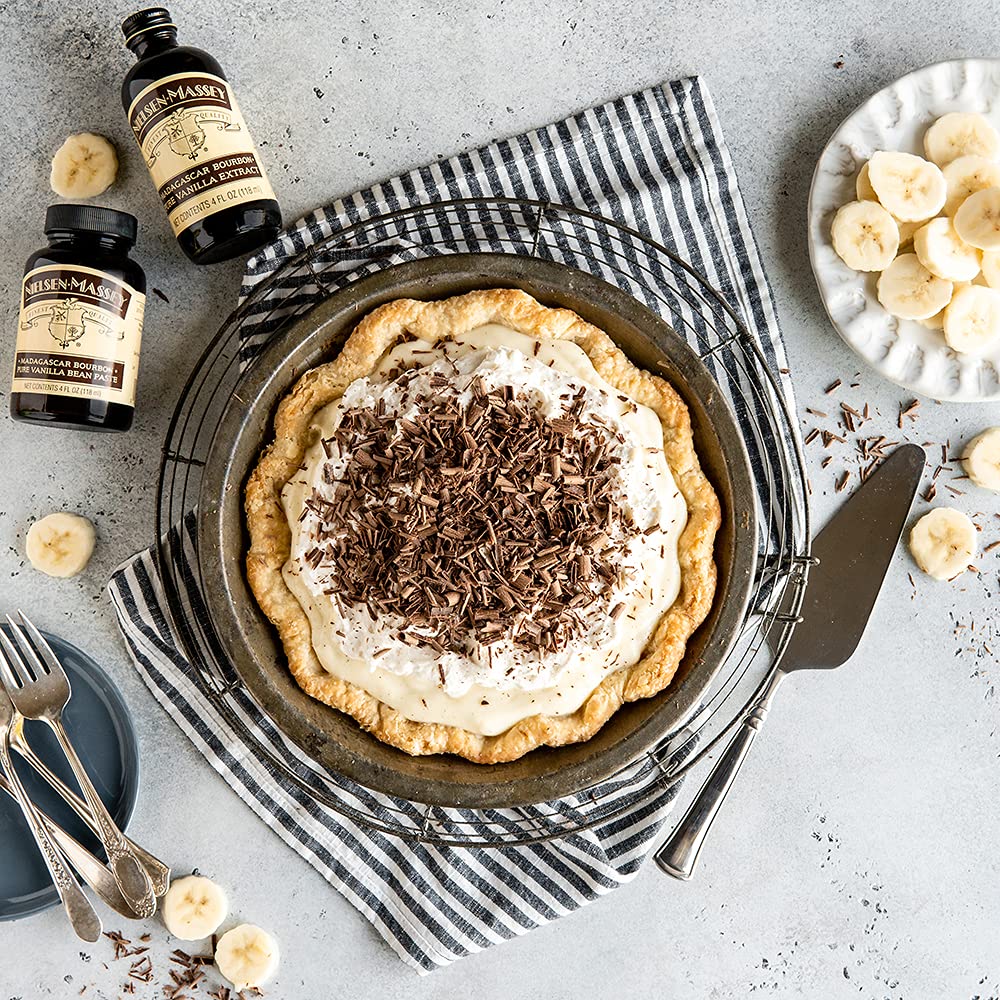
If you’ve ever stood in the baking aisle holding a $6 bottle of McCormick Pure Vanilla Extract in one hand and a $22 bottle of Nielsen-Massey Madagascar Bourbon Pure Vanilla Extract in the other, you’ve felt this exact tension. Vanilla extract, at its simplest, is vanilla bean flavor dissolved into alcohol — the alcohol pulls out the aromatic compounds from the bean so you can stir them into your batter without grinding up a bean by hand. “Pure” vanilla extract (as opposed to “imitation,” which uses synthetic vanillin) comes from real beans. But “pure” is a wide tent: a $6 bottle and a $22 bottle can both legally wear that label. What actually differs is the bean quality, origin, extraction process, and concentration — and whether those differences matter to your baking is what this article is built to answer.
By the end, you’ll have a clear decision framework: what the premium buys you, where the store-brand holds its own, and the math that actually drives the right choice for how you bake.
| EDITOR'S PICKNielsen-Massey Madagascar Bourb… | Mid-tierKirkland Signature Pure Vanilla | Budget pickMcCormick Vanilla Extract | |
|---|---|---|---|
| Volume | 8 fl oz | 16 oz | 2 fl oz |
| Origin | Madagascar | — | Madagascar |
| Corn syrup | — | — | ✗ |
| Gluten-free | — | — | ✓ |
| Kosher | — | — | ✓ |
| Price | $34.14 | $20.99 | $7.00 |
| See on Amazon → | See on Amazon → | See on Amazon → |
What You’re Actually Comparing
Let’s name the three players clearly before we get into performance differences.
Nielsen-Massey Madagascar Bourbon Pure Vanilla Extract is the brand most often cited when professional bakers and serious home bakers talk about “the good stuff.” It uses vanilla beans from Madagascar — the island produces roughly 75–80% of the world’s vanilla supply, per Nielsen-Massey’s own sourcing documentation — and the company uses a cold extraction process they’ve refined over more than a century. “Bourbon” in this context doesn’t mean whiskey; it refers to the Bourbon Islands (Réunion and Madagascar), the regional designation for Vanilla planifolia grown there. The flavor profile reviewers consistently describe is smooth, rounded, and rich — a classic vanilla warmth without sharp or harsh edges.
McCormick Pure Vanilla Extract is the category standard-bearer at the store-brand tier. It’s widely available, consistent from bottle to bottle, and the flavor is familiar to virtually every American baker who grew up baking from a recipe box. McCormick loyalists aren’t wrong to stick with it — Cook’s Illustrated’s blind tasting data notes that it performs reliably in cooked applications, and its consistency across production runs is a real operational virtue for high-volume bakers.
Kirkland Signature Pure Vanilla Extract (Costco’s house brand) is the value-optimization play. It sells in large bottles at a cost-per-ounce that undercuts both competitors significantly, and Kirkland vanilla buyers are notably satisfied in aggregated reviews — frequently reporting that it outperforms its price point in blind side-by-sides. The practical caveat: Kirkland vanilla ships in glass bottles, and reviewers have flagged a recurring frustration with packaging (bottles shipped in soft envelopes rather than padded boxes), creating real breakage risk for online orders.
The Flavor Difference: Real, But Context-Dependent
Here’s the honest practitioner answer: yes, there is a perceptible difference — but the gap narrows dramatically with heat.
King Arthur Baking Company’s vanilla ingredient guide makes this point directly: volatile aromatic compounds (the molecules that carry vanilla’s complex floral, creamy, and spiced notes) evaporate during high-heat baking. When you bake a vanilla cake at 350°F for 35 minutes, a meaningful percentage of the delicate top notes that distinguish a premium extract simply cook off. What survives is primarily vanillin — the core vanilla compound that both premium and store-brand extracts contain. This is why Cook’s Illustrated’s blind tasting results consistently show that flavor gaps between extract tiers compress in baked applications and widen in cold, uncooked, or lightly heated ones.
Serious Eats’ vanilla extract analysis supports the same conclusion: the most reliable differentiation zone for premium vanilla is uncooked or minimally cooked formats — buttercream frosting, whipped cream, no-bake cheesecake, pastry cream, ice cream, and cold preparations like milkshakes. In those applications, the full aromatic complexity of a quality extract can express itself. One pattern that shows up consistently in Nielsen-Massey reviews is the “aha” moment coming from unexpected uses: people report the flavor difference being most obvious not in pound cake but in cold drinks, smoothies, and whipped toppings where nothing is cooking off.
For high-heat applications — quick breads, muffins, most drop cookies, standard layer cakes — the practical performance difference between Nielsen-Massey and a quality store-brand like McCormick narrows to a point where most palates, including trained ones, struggle to consistently distinguish them in blind tastings.
The decision inflection point: Are your highest-stakes applications cooked or uncooked? That single variable should drive most of your purchasing logic.
By the Numbers
| Extract | Approx. price per fl. oz. (2026) | FDA minimum vanilla bean content | Best application tier |
|---|---|---|---|
| Nielsen-Massey Madagascar Bourbon | ~$1.30–$1.80/fl. oz. | Meets or exceeds | Cold, uncooked, precision flavor work |
| McCormick Pure Vanilla | ~$0.50–$0.70/fl. oz. | Meets minimum | High-heat baking, high-volume work |
| Kirkland Signature Pure Vanilla | ~$0.25–$0.40/fl. oz. | Meets minimum | Value-driven, large-batch applications |
Prices reflect approximate retail and online averages as of mid-2026. Per-ounce cost shifts considerably when buying 4-oz. vs. 16-oz. bottles — calculate by size before assuming McCormick is always the middle ground.
The Loyalty Patterns Tell You Something
One of the most useful ways to read the brand comparison is to look at why each group stays loyal — because the reasons are genuinely different, and they’re all rational.
Nielsen-Massey loyalists tend to describe a flavor transformation moment — often a specific recipe where the extract made a noticeable difference. The Serious Eats vanilla analysis notes that premium vanilla extracts create what reviewers often call “layers” or “depth” that’s hard to articulate but easy to notice in neutral-background applications: vanilla pudding, plain sugar cookies, simple buttercream. The flavor is doing more work because there’s less competing with it.
McCormick loyalists are explicit about consistency being the value, not just price. Multiple reviewers across aggregated sources describe returning to McCormick after experimenting with other brands — not because McCormick won a flavor contest, but because it behaves predictably. For a baker running a cottage business or a home baker who bakes the same three recipes reliably, that predictability has real value. You know exactly how much to add. There are no surprises.
Kirkland buyers are running pure cost-per-unit logic, and they’re largely right to. The Kitchn’s extract comparison work found that value-tier pure vanilla extracts often outperform their price positioning significantly in baked applications — and Kirkland specifically benefits from Costco’s sourcing leverage, which allows it to use a quality ingredient at a margin structure most smaller brands can’t touch. The breakage/shipping risk is real and worth noting before ordering a large bottle online rather than picking it up in-store.
McCormick Small Batch: The Middle Ground Worth Knowing
One brand sub-tier that deserves a standalone mention: McCormick Small Batch Vanilla Extract. This is a meaningfully different product from standard McCormick Pure Vanilla, and it’s often overlooked in the binary “budget vs. premium” framing.
McCormick Small Batch uses Tahitian vanilla beans (Vanilla tahitensis) rather than the Madagascar Vanilla planifolia used in their standard extract. Tahitian vanilla has a distinct sensory profile — floral, cherry-adjacent, more delicate than the robust warmth of Bourbon-type vanilla. The Kitchn’s comparative tasting notes describe it as noticeably brighter and more aromatic. This isn’t simply “better McCormick” — it’s a different flavor character that may or may not suit your application. In a neutral vanilla custard or simple buttercream, Tahitian vanilla’s floral notes can be genuinely beautiful. In a recipe where vanilla is a supporting player behind warm spices or chocolate, that delicacy can get lost.
If you’re currently buying standard McCormick and feeling like something’s missing, Small Batch is a more instructive experiment than jumping straight to Nielsen-Massey — it helps you isolate whether the issue is quality or flavor profile, two different problems with different solutions.
The Annual Usage Math (and Why It Changes the Right Answer)
The typical home baker uses approximately 1 to 3 cups of vanilla extract per year, based on usage patterns documented across baking community surveys and ingredient guide estimates from King Arthur Baking Company. That’s roughly 8 to 24 fluid ounces annually.
At the high end of that range — 24 oz. per year — the annual cost difference between Nielsen-Massey and McCormick is roughly $18 to $26 per year at mid-2026 pricing. That’s the actual stakes of the “premium vs. store-brand” decision for most home bakers. Framed that way, the premium is much easier to justify than the per-bottle sticker suggests.
For small-batch bakery owners or professional confectioners working through gallon quantities, the math inverts. A gallon of high-quality pure vanilla from a bulk supplier like OliveNation or Spice Jungle — both carry professional-grade options — runs $80–$200 depending on origin and concentration. At that volume, even a modest cost-per-ounce advantage compounds meaningfully across a year. Professional buyers also frequently use vanilla in recipes where it’s a background note among many, further shifting the calculus toward reliability and cost over sensory peak performance.
Frequently Asked Questions
Is Nielsen-Massey vanilla extract really better than McCormick for baking, or is it marketing?
Both, honestly. There is a real and documented sensory difference — but it’s most audible in uncooked or minimally heated applications. In high-heat baking, the gap narrows to a point that’s difficult to consistently perceive. Cook’s Illustrated’s blind tasting work supports this conclusion: premium extracts earn their premium most clearly outside the oven.
Does the flavor difference between premium and store-brand vanilla survive high-heat baking?
Partially. The core vanillin note survives heat well in all pure vanilla extracts. The more complex aromatic compounds — the floral, creamy, and nuanced notes that distinguish a premium extract — are partially volatile and cook off at sustained high temperatures. The difference that remains is real but subtle, and most palates won’t consistently detect it in a fully baked product.
Is Kirkland Signature vanilla extract the same quality as Nielsen-Massey?
No, but it punches well above its price. Kirkland uses a different bean sourcing and extraction approach, and reviewers generally rate its flavor as very good — not at the same level as Nielsen-Massey in nuanced applications, but entirely satisfying for everyday baking. Its primary advantage is cost-per-ounce; its practical disadvantage for online buyers is packaging fragility.
How much vanilla extract does a typical home baker use per year, and does that change which size to buy?
King Arthur Baking Company’s usage guidance suggests most active home bakers consume 1 to 3 cups (8–24 fl. oz.) annually. At that range, buying a 4-oz. bottle of Nielsen-Massey every 1–2 months is cost-comparable to buying an 8-oz. bottle less frequently — check per-ounce pricing before defaulting to the smaller size. For heavy bakers, the 8-oz. Nielsen-Massey format often offers better value per ounce than the 4-oz.
Is McCormick Small Batch vanilla noticeably different from standard McCormick pure vanilla?
Yes — and the difference is bean variety, not just quality tier. Standard McCormick uses Madagascar Bourbon vanilla (Vanilla planifolia); Small Batch uses Tahitian vanilla (Vanilla tahitensis), which has a distinctly floral, lighter character. If you find Bourbon-type vanilla too heavy or one-dimensional for a specific application, Small Batch is worth the experiment. It’s a genuine product differentiation, not just marketing.
If X, Then Y: The Decision Matrix
-
If your highest-stakes applications are uncooked (buttercream, whipped cream, no-bake desserts, pastry cream): Nielsen-Massey is worth the premium. This is the zone where the sensory difference is most reliable and most likely to be tasted.
-
If you bake mostly at high heat (cakes, quick breads, muffins, cookies): Quality store-brand pure vanilla — McCormick or Kirkland — delivers nearly equivalent results at meaningfully lower cost. Use the savings to buy a better bean for your next bean-forward application.
-
If you’re running a small-batch bakery or professional operation: Bulk pure vanilla from a professional supplier is almost certainly your best cost structure. The format advantage outweighs the brand premium at volume.
-
If you want to move up from standard McCormick without committing to the full premium tier: McCormick Small Batch is the most instructive next step — it isolates the flavor-profile variable before you make the jump to single-origin pricing.
-
If you bake occasionally and keep a bottle for months: Buy the smaller Nielsen-Massey size. Vanilla extract is shelf-stable for years, but the per-year cost difference at low usage volume is small enough that the flavor upside is worth it — and a single impressive vanilla custard will confirm why the bottle exists.