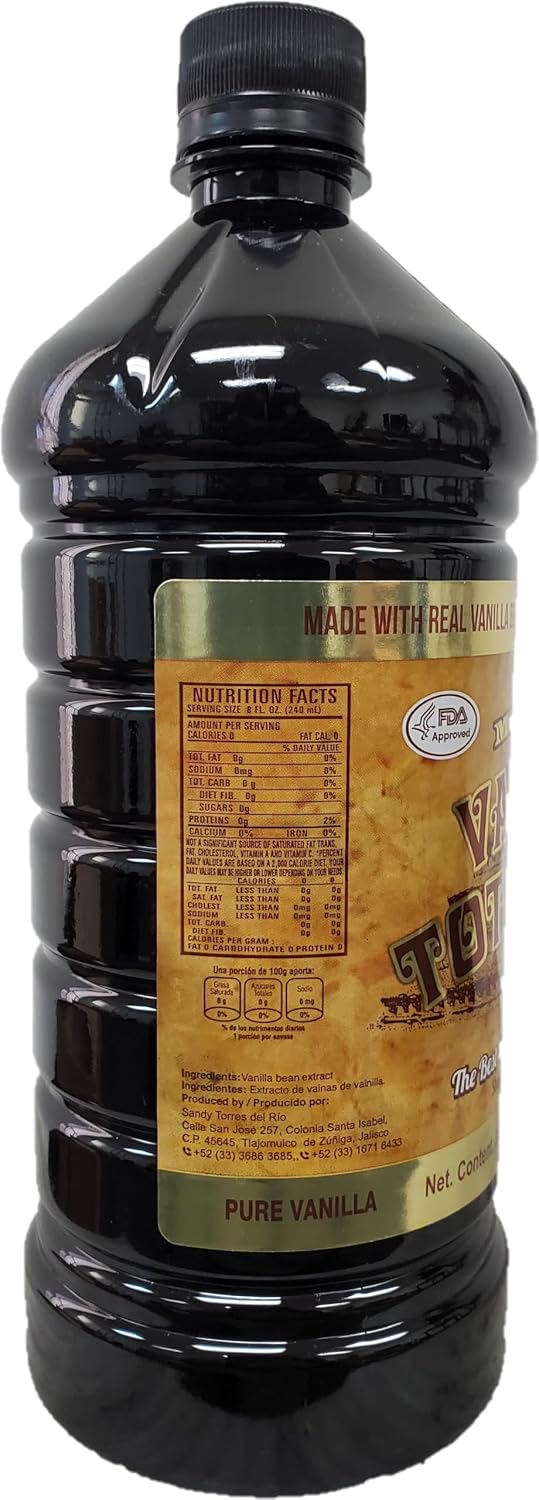
If you’ve ever come home from a trip to Mexico carrying a big bottle of vanilla labeled “Extracto de Vainilla” for a few dollars, you already know the appeal: Mexican vanilla has a reputation for being rich, slightly smoky, and wonderfully fragrant. But flip that bottle around and you’ll often find the word blend somewhere on the label — and that single word can mean the difference between a genuinely excellent product and one that’s mostly alcohol, artificial flavoring, and marketing. An extract (the concentrated flavor compound pulled from real vanilla beans using alcohol and water) is a very different product from an imitation or a blend, even if all three bottles smell good in the store. This guide breaks down exactly what’s in Mexican vanilla bottles at every price tier, explains what “blend” actually signals on a label, flags the one historical safety concern you should still know about, and ends with a clear decision framework for home bakers and small-batch professionals sourcing by the bottle or by the gallon.
Why Mexican Vanilla Has a Complicated Reputation
Mexico is vanilla’s ancestral home. Vanilla planifolia — the species that produces the vast majority of the world’s vanilla beans — originated in the Totonac region of Veracruz, Mexico, and was cultivated there long before Spanish colonizers brought it to Europe in the 1500s. The flavor profile that serious bakers associate with Mexican vanilla is distinctive: earthier and woodsier than the creamy, custard-forward Madagascar Bourbon style, with a subtle smokiness that works especially well in chocolate applications, spiced cookies, and anything with warm baking spices.
So the beans themselves are real and historically significant. The complication isn’t the source — it’s the labeling.
For decades, coumarin (a naturally occurring compound found in tonka beans, sweet clover, and some synthetic vanilla formulas) was added to cheap Mexican vanilla products sold at border markets and tourist shops. Coumarin produces a warm, almost cinnamon-like note that amplifies vanilla’s fragrance, and it made those cheap products smell extraordinary on the shelf. The FDA banned coumarin as a food additive in the United States in 1954 because high doses showed liver-toxic effects in animal studies. Per the FDA’s own import alert records, coumarin-adulterated vanilla products continued appearing in border-market imports sporadically well into the 2000s.
The good news: reputable commercial producers — including brands sold through major U.S. retail and wholesale channels — are fully compliant and have been for years. But this history is why reading the label matters, and why “blend” deserves scrutiny.
Decoding ‘Blend’ on a Mexican Vanilla Label
“Blend” is not a regulated term under the FDA’s Standard of Identity for vanilla extract (21 CFR § 169.175). That standard defines pure vanilla extract as a product made from vanilla beans, water, and at least 35% alcohol by volume, with a minimum of 13.35 ounces of vanilla beans per gallon. It says nothing about what “blend” means when it appears on a label, which is precisely the problem.
In practice, “blend” on a Mexican vanilla label is doing one of three very different jobs:
1. Bean-origin blend (best case). A handful of premium producers use “blend” to mean they’re combining Mexican Vanilla planifolia beans from multiple growing regions — say, Papantla and Oaxaca — to achieve a consistent flavor profile across harvests. This is analogous to how whiskey distillers blend barrels. The product is still 100% pure extract; the blend refers only to the beans, not the formulation. These bottles typically meet or exceed the FDA standard and will say “pure vanilla extract” prominently.
2. Pure + imitation blend (common mid-tier case). Here, the producer is stretching a small amount of real vanilla extract with vanillin — the primary flavor compound in vanilla, which can be synthesized from wood pulp lignin, guaiacol, or rice bran. This is legal, and the product will often be labeled something like “pure and natural vanilla” or “vanilla extract blend.” The vanillin gives a clean, sharp vanilla hit; the real extract provides depth. Cook’s Illustrated has noted in its vanilla coverage that blended products of this type can actually perform reasonably well in baked goods where high heat drives off the more volatile flavor compounds anyway.
3. Imitation-forward blend (buyer beware). At the lowest price tier, “blend” can mean the product is primarily propylene glycol (a carrier solvent), water, artificial vanillin, and coloring — with a trace of real extract added to justify the word “vanilla” on the front. These products sometimes use coumarin analogs or other flavor enhancers. They’re not necessarily unsafe when purchased from reputable importers, but they’re not delivering what most bakers expect when they reach for “Mexican vanilla.”
The Label Checklist
Before you buy, run through these four checkpoints:
- Does it say “pure vanilla extract” prominently? If yes, the FDA standard applies and you have real bean-based extract.
- Is the alcohol content listed? Pure extract must be at least 35% ABV. Many tourist-market bottles don’t disclose this.
- Is the ingredient list short? Water, alcohol, vanilla bean extractives = good. Propylene glycol, caramel color, artificial flavor in the first three ingredients = proceed with caution.
- Is the brand distributed through a U.S. regulated supply chain? Products sold through major U.S. wholesale and retail channels face FDA import compliance. Border-market and direct-import bottles do not carry the same guarantee.
By the Numbers: Mexican Vanilla at a Glance
| Format | Typical retail price | FDA “pure” compliant? | Best use case |
|---|---|---|---|
| Tourist-market blend (8 oz) | $3–$8 | Often not confirmed | Not recommended for professional use |
| Mid-tier blend (e.g., Molina, 8 oz) | $6–$12 | Partially (pure + imitation) | Everyday baking where cost matters |
| Pure Mexican extract, domestic brand (4 oz) | $14–$22 | Yes | High-heat applications, chocolate |
| Premium single-origin Mexican (4 oz) | $28–$45 | Yes | Showcase recipes, chocolate ganache |
| Professional bulk pure Mexican (1 gal) | $90–$160 | Yes | High-volume professional kitchens |
Which Mexican Vanilla Bottles Are Actually Worth Buying
For the Home Baker: Molina Vanilla
Molina Vanilla is the brand name most frequently cited by home bakers making the jump from imitation to something with more character on a budget. It’s a blend — specifically a pure-and-imitation formulation — and Molina is transparent about this in its U.S.-market labeling. The ingredient list includes vanilla extractives alongside vanillin.
What aggregated reviews consistently note about Molina: it performs well in high-temperature baked goods (cookies, brownies, muffins) where the nuance gap between pure and blended extract narrows significantly under heat. It’s widely available through major U.S. grocery and wholesale club channels at a price point that makes it an easy yes for everyday volume baking.
The honest trade-off: in applications where vanilla is the star and heat is low or absent — a cold buttercream, a no-bake custard, a whipped cream — experienced bakers in long-form review threads report that Molina reads slightly thin compared to single-origin pure extracts. That’s the blend showing its hand.
Decision rule: If you’re baking more than 3–4 batches a week and cost-per-use matters, Molina is a defensible choice for your workhorse vanilla. It is not the bottle you reach for when the vanilla flavor is front and center.
For the Intermediate Baker: Nielsen-Massey Mexican Pure Vanilla Extract
Nielsen-Massey — a brand with a strong reputation across the serious home-baking and professional community — produces a Mexican-origin pure vanilla extract made to their standard extraction specifications. King Arthur Baking Company, which carries Nielsen-Massey and has published detailed vanilla guides, positions their Mexican extract as producing a “smooth, velvety flavor with a hint of spice” that’s notably different from their Madagascar Bourbon offering.
Per published product specifications, Nielsen-Massey’s Mexican extract uses cold extraction to preserve more of the delicate top notes in the bean’s aromatic profile. Reviewers at Serious Eats and broader pastry communities note that it delivers more depth than mass-market blends in uncooked or lightly heated applications, while the earthier, woodsier character distinguishes it clearly from Bourbon-type extracts.
Decision rule: If you’re already comparing single-origin extracts and you want to explore the Mexican flavor profile without sourcing from gray-market channels, Nielsen-Massey Mexican is the right starting point. At roughly $14–$20 for 4 oz depending on the retailer, it’s a meaningful upgrade from blended products.
For Professional Volume: OliveNation and Beanilla Bulk Pure Mexican
For small-batch bakery owners and artisan confectioners sourcing by the quart or gallon, OliveNation and Beanilla both carry professional-grade pure Mexican vanilla extracts through their wholesale and direct-to-consumer channels. Both brands are frequently cited in professional pastry forums as reliable compliant sources — meaning their products meet FDA standard-of-identity requirements for pure vanilla extract and are manufactured in facilities with proper traceability documentation.
The cost math at scale favors these channels significantly. A gallon of pure Mexican extract from a supplier like OliveNation typically runs $90–$160 (as of mid-2026 market pricing), compared to the equivalent volume cost of retail 4 oz bottles, which would run $140–$200+. For a bakery moving 10–15 gallons of vanilla annually, that differential is material.
Decision rule: If your operation uses more than a liter of vanilla per month and you’re currently buying retail bottles, moving to a bulk supplier for your Mexican vanilla — provided it’s a documented pure extract — almost certainly pencils out within two to three months of volume.
Mexican vs. Madagascar: When Does the Origin Actually Matter?
This is the question underneath the buying decision, and it deserves a direct answer.
The Bourbon-type vanilla from Madagascar (and also grown in Indonesia and Uganda) is sweeter, creamier, and richer in vanillin content — roughly 2% vanillin by weight in a good Bourbon bean versus slightly lower in Mexican planifolia. It’s the flavor most people grew up associating with “vanilla.”
Mexican planifolia from well-managed growing operations produces beans with a more complex secondary aromatic profile: earthy, slightly woody, with coumarin-adjacent spice notes (from the bean’s natural chemistry, not added coumarin) and a smokiness that serious bakers find compelling in specific applications.
Per flavor pairing research referenced in Spice Trekkers’ Mexican vanilla origin documentation, Mexican vanilla tends to perform particularly well alongside:
- Dark and bittersweet chocolate
- Cinnamon, clove, and cardamom
- Brown butter and toffee
- Aged cheeses in savory-adjacent baking
It tends to be less assertive than Madagascar Bourbon in applications where you want clean, sweet vanilla to stand alone — vanilla bean ice cream, white chocolate ganache, or a simple vanilla sponge where the extract is doing all the flavor lifting.
The if/then: If your application is chocolate-forward or spice-forward, a quality pure Mexican extract is worth the intentional swap. If vanilla is the primary and only flavor, a Madagascar Bourbon or a Tahitian (for florality) will likely outperform in the cup or on the plate.
The Bottom Line
Mexican vanilla is genuinely worth exploring — but the label matters more here than with almost any other extract category. “Blend” can mean something respectable (a pure extract from multiple growing regions) or something that’s mostly synthetic vanillin in a brown bottle. Run the four-point label checklist before you buy. For home bakers building intuition around single-origin extracts, Nielsen-Massey Mexican is the entry point worth starting with. For professionals buying in volume, document your sourcing chain and do the cost-per-gallon math — it almost always favors bulk. And when the recipe calls for chocolate or spice, give Mexican vanilla a serious look: in the right application, it’s not a compromise, it’s the right call.