If you’ve ever grabbed a tiny LorAnn dram bottle — one of those small, one-dram vials of intensely concentrated flavoring — and added what felt like a reasonable amount to a cake batter, only to produce something that could strip paint, you already understand the core problem this article is here to solve. Flavor formats are not interchangeable. A super-strength flavor oil (a highly concentrated flavoring dissolved in an oil base, with no water or alcohol) behaves completely differently than a bakery emulsion (flavor suspended in a water-and-glycerin base that was specifically engineered to survive heat) or a natural fruit extract (flavor compounds drawn out of actual fruit and dissolved, usually in alcohol). Each format has a different concentration level, a different carrier ingredient, and a different relationship with heat. Pick the wrong one for your application, and you’re either wasting money on flavor that bakes off entirely or blowing the palate of everyone at the table. This guide breaks down exactly when to reach for which format — and shows the math so you can make the call confidently.
The Carrier Is the Story: What Each Format Actually Is
The flavoring world makes this confusing by using “extract,” “oil,” “emulsion,” and “flavoring” somewhat loosely on labels. Let’s pin down what each format actually means in practical terms before comparing their behavior.
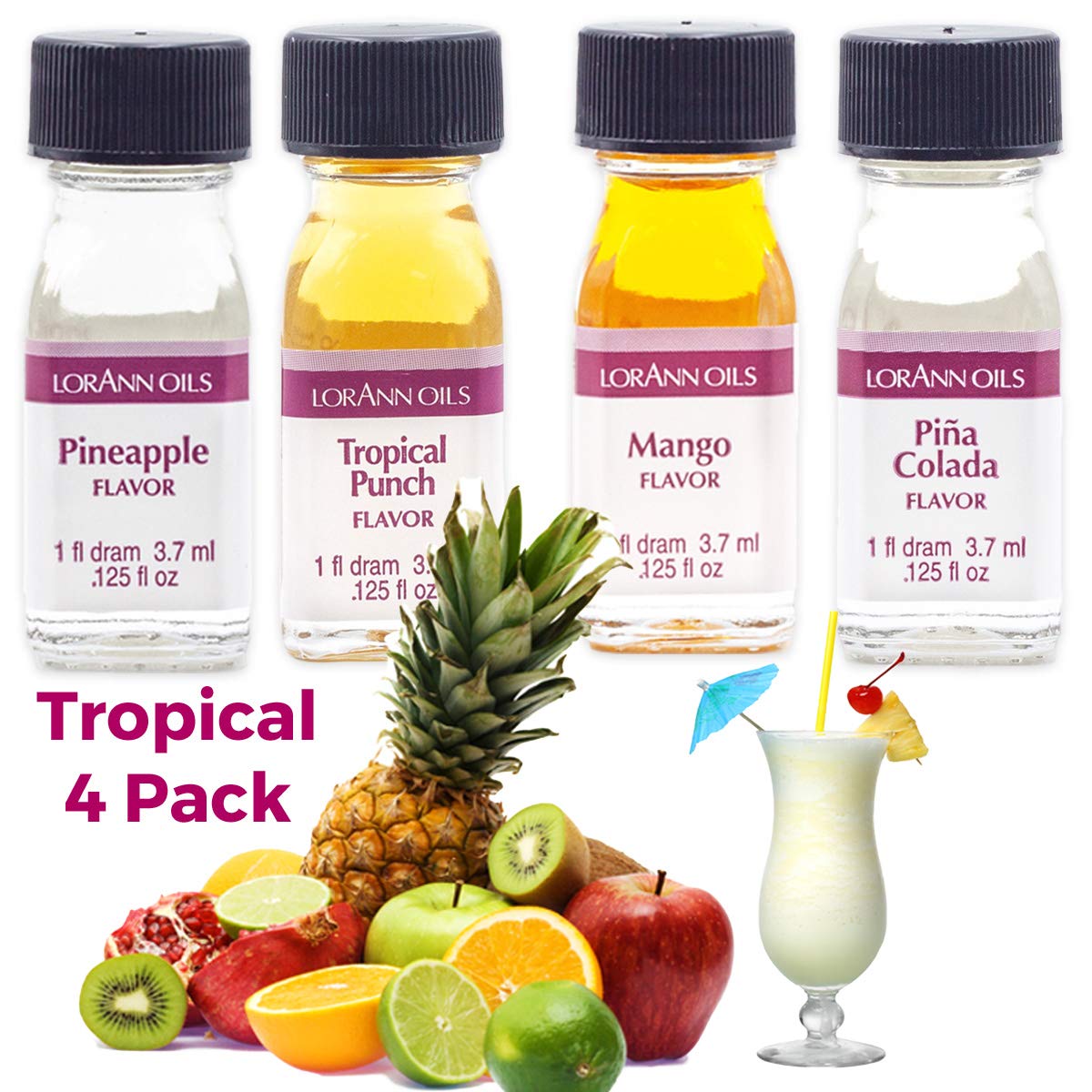
Super-strength flavor oils — LorAnn’s core product line being the most recognizable — are lipid (fat) based. The flavor compounds are dissolved directly in an oil medium. Because many of the aromatic molecules that make up fruit, nut, and candy flavors are themselves oil-soluble rather than water-soluble, oil-based carriers can hold an extraordinarily high concentration of flavor. That’s why LorAnn’s 1-dram bottle (roughly ¾ teaspoon) is labeled as equivalent to one full bottle of regular extract. No alcohol, no water — just concentrated flavor in oil.
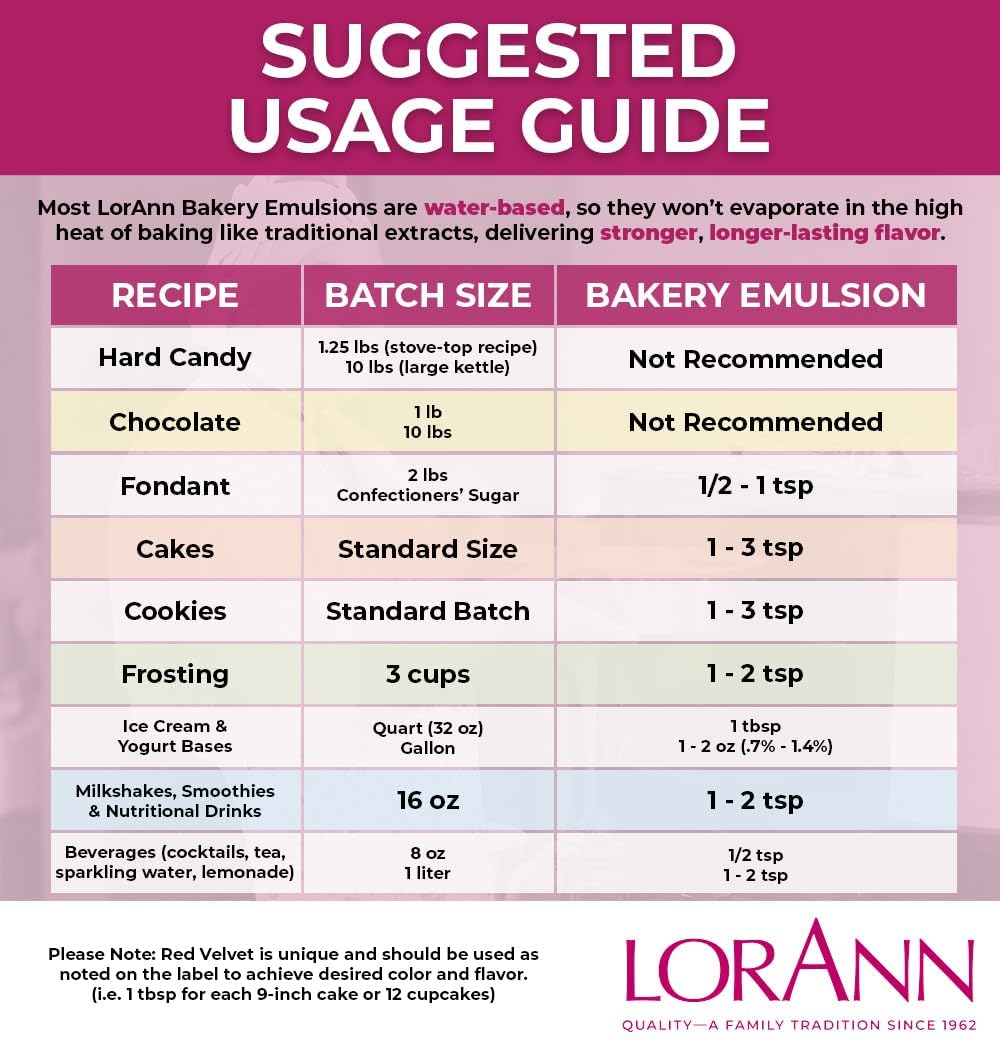
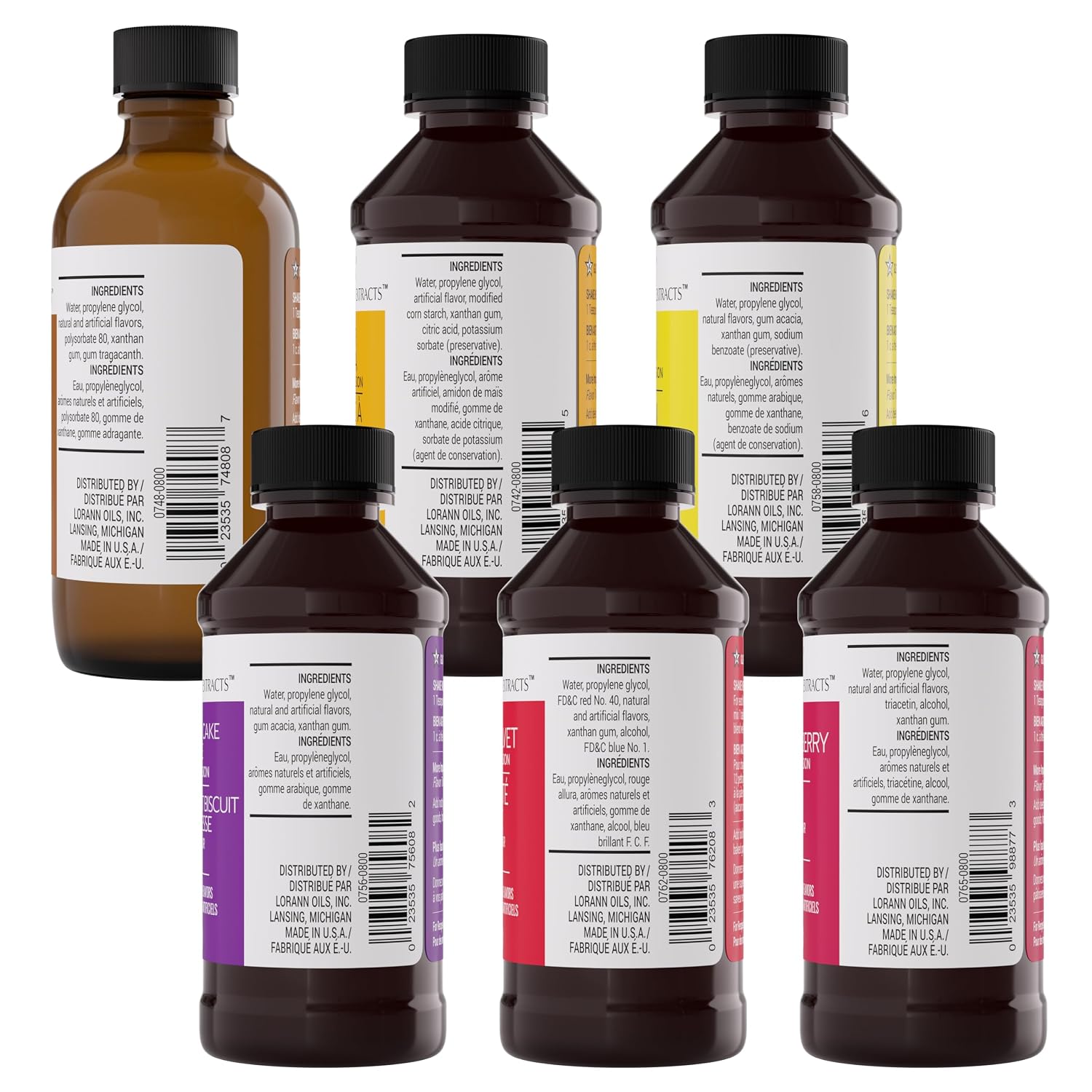
Bakery emulsions are a hybrid technology. Flavor compounds are suspended in a water-glycerin base using an emulsifier, which keeps the oil-based flavor molecules evenly distributed in a water-based liquid (an emulsifier is an ingredient — like lecithin — that bridges fat and water so they don’t separate). Because they’re water-based at the macro level, emulsions integrate smoothly into batters and frostings without the greasy sheen or separation risk you can sometimes get with straight oil additions. The Wilton and LorAnn emulsion lines, as well as specialty options from bakery suppliers, are purpose-built to deliver flavor that holds up in high-heat applications.
Natural fruit extracts — the OliveNation berry and citrus lines, the Bakto Flavors specialty fruit set, and comparable products — are typically alcohol-based, similar in structure to vanilla extract but made from actual fruit components. The alcohol carries the flavor compounds into the batter, then largely evaporates during baking. This is both their strength and their Achilles heel, which we’ll get to shortly.
King Arthur Baking Company, in their overview titled “Understanding Extracts, Emulsions & Flavor Oils,” notes that the carrier medium fundamentally determines how a flavoring integrates into a formula — not just in terms of flavor intensity, but in how the flavoring interacts with fats, moisture, and heat over time.
Heat Is the Filter: Why “Baking Off” Is the Core Variable
Here’s the decision framework that should drive your format choice: How much heat will this flavoring experience, and for how long?
Alcohol evaporates at around 173°F (78°C). Most cake batters reach internal temperatures of 200–210°F before they’re done. That means any alcohol-carried flavor compound that isn’t physically bonded to fat, starch, or protein in the batter is a genuine flight risk. Natural fruit extracts — with their alcohol base — face this evaporation window in every baked application. The flavor can and does survive baking, but you’re working against physics: the more delicate or volatile the fruit flavor compound, the more of it escapes with the alcohol.
Oil-based flavor compounds, by contrast, are not volatile in the same way. The fat carries them through the bake and keeps them encapsulated in the fat network of the crumb. Fine Cooking, in their article “Baking with Flavor Oils and Emulsions,” confirms that oil-soluble flavors are the professional standard for candy making specifically because they tolerate the high, sustained heat of sugar work — temperatures that would completely destroy any alcohol-based flavoring.
Bakery emulsions occupy the middle ground deliberately. The glycerin-water base is more heat-stable than straight alcohol, and the emulsification keeps flavor molecules more physically distributed throughout the batter matrix — meaning they bond to more of the batter’s infrastructure before heat exposure rather than remaining free-floating. The Kitchn, in their piece “Emulsions vs. Extracts: What’s the Difference?,” describes this bonding behavior as the primary reason emulsions are favored for white and yellow cakes, where a pure alcohol extract might leave the flavor smelling stronger in the bowl than it tastes in the finished slice.
Serious Eats, in their editorial “The Science of Vanilla Extract,” notes that professional pastry kitchens often use a layered approach — a heat-stable emulsion or oil in the batter, with a small addition of a natural extract folded into the frosting or filling — to achieve full-spectrum flavor across both cooked and uncooked components of a single dessert. The principle applies equally to fruit flavors.
Which Format Wins Where: A Three-Tier Comparison
LorAnn Super-Strength Flavor Oils — Best for Extreme Heat Applications
Lorann
$33.99
In stock on Amazon
Check price on AmazonSuper-strength oils are the right call when you’re working with candy, chocolate bark, hard-shell coatings, or anything where the sugar mass itself is the vehicle and there is no water matrix to distribute flavor. The oils integrate cleanly into meltable candy wafers and white chocolate applications because fat welcomes fat — no risk of the chocolate seizing (seizing means the cocoa butter suddenly clumps when it contacts water, turning smooth chocolate into a grainy paste).
For cake and buttercream applications, the super-strength concentration means the margin for error is extremely small. LorAnn’s own product documentation states that 1 dram (approximately ¾ teaspoon, or roughly 40–50 drops depending on viscosity) is equivalent to one 1-ounce bottle of regular extract. Working backward: 1 teaspoon of standard extract is approximately 10–12 drops of super-strength oil. Treat this as a starting ceiling, not a floor — you can always add more, but you cannot un-add.
One important structural caveat: oil-based flavors can affect the fat balance in a delicate batter, particularly high-ratio cakes with precise fat ratios, where even a small addition of extra oil can affect crumb structure at the margins. For buttercream and frosting, the swap is more forgiving. For candy and chocolate work, this format has no peer.
Bottom line: Reach for super-strength oils when heat is extreme, when you’re working with a fat-based medium like chocolate, or when you need maximum concentration in minimum volume.
Lorann
$33.99
In stock on Amazon
Check price on AmazonBakery Emulsions — The Professional Workhorse for Cakes and Buttercream

Bakto
$25.99
In stock on Amazon
Check price on AmazonBakery emulsions are the workhorse format for layer cakes, sheet cakes, muffins, and buttercream at both home-bakery and professional scale. Strawberry emulsion in cupcakes, almond emulsion in celebration cakes — these formats show up repeatedly in professional-context applications because emulsions were engineered for exactly this use case.
The glycerin base also has a slight hygroscopic quality (meaning it attracts and retains a small amount of moisture), which can contribute to perceived moistness in crumb — a secondary benefit that oil and alcohol-based formats don’t offer. This is a meaningful advantage in high-volume bakery production where shelf life and perceived freshness matter.
Emulsions typically run at roughly 1–2× the effective strength of a standard extract, which puts them in an easy dosing range: start with the same volume you’d use for a regular extract, then adjust modestly upward based on the intensity you want. Because the base is water-and-glycerin rather than concentrated oil, over-pouring produces a flavor that’s too strong but doesn’t risk the fat-ratio disruption that over-pouring a super-strength oil can introduce.
Bottom line: For standard baking temperatures, cakes, cookies, and buttercream, bakery emulsions offer the most forgiving dose range with reliably strong post-bake flavor. This is where most intermediate-to-professional bakers should spend their flavoring budget.
Bakto
$25.99
In stock on Amazon
Check price on AmazonNatural Fruit Extracts — Best for No-Bake and Low-Heat Applications
LorAnn
$9.02
In stock on Amazon
Check price on AmazonNatural fruit extracts genuinely shine in no-bake and low-heat applications: no-bake cheesecake fillings, cold-process buttercream, pastry cream (cooked gently on the stovetop), fruit curd, flavored whipped cream, and mousse. OliveNation’s berry and citrus extract lines consistently receive praise from professional confectioners for being clean-label — no added sugar, no corn syrup — and for carrying a fruit-forward flavor profile that reads closer to actual fruit than synthetic candy flavoring. That character is exactly what you want in a diplomat cream or a delicate gelée.
It’s also why these extracts can feel flat if you add them to a cake batter without compensating with significantly higher volume or post-bake application. The alcohol evaporation problem is real: when the batter’s internal temperature exceeds the boiling point of ethanol during baking, alcohol — and the volatile flavor compounds traveling with it — escapes. Delicate fruit top notes (the bright, high-pitched aromatic impression you get from fresh strawberry or peach) are the most volatile and therefore the most vulnerable.
One practical note on dropper-less bottles (a common packaging choice in the specialty extract category): with a free-pour bottle of a relatively potent extract, it is genuinely possible to over-pour before you’ve registered what happened. If you’re working with any high-quality fruit extract in a small-batch formula, transfer a working portion to a dropper bottle before you start. This is a process habit, not a product criticism.
Bottom line: Natural fruit extracts earn their price point in no-bake preparations, cold fillings, and pastry applications where gentle heat preserves their clean-label fruit character. For baked applications, compensate by increasing volume 30–50% or by adding a second application to the frosting or filling post-bake.
LorAnn
$9.02
In stock on Amazon
Check price on AmazonFormat Comparison at a Glance
| Format | Typical Concentration | Heat Stability | Primary Application |
|---|---|---|---|
| Super-strength flavor oil | ~4–5× standard extract | Very high | Candy, chocolate, high-heat items |
| Bakery emulsion | ~1–2× standard extract | High | Cakes, buttercream, cookies |
| Natural fruit extract | ~1× standard extract | Moderate | No-bake, custards, frosting, light baking |
Frequently Asked Questions
Can I substitute a LorAnn super-strength oil for a bakery emulsion in a cake recipe?
Technically yes, but the substitution requires a dosing adjustment and some tolerance for risk. LorAnn’s product documentation suggests using ¼ to ½ teaspoon of super-strength oil in place of one teaspoon of regular extract. For an emulsion, which is already stronger than a standard extract, start at the low end — around 8–10 drops — and adjust from there. The more important caveat: oil-based flavors can affect the fat balance in a delicate batter, where a small addition of extra oil can affect crumb structure at the margins. For buttercream and frosting, the swap is more forgiving.
Why does my fruit extract flavor disappear after baking?
This is the alcohol evaporation issue described above. Solutions: switch to a bakery emulsion for baked applications, increase extract quantity by 30–50% to compensate for loss, or add a small amount of extract to the frosting post-bake to restore the fresh-fruit signal.
Do bakery emulsions work in candy making the same way LorAnn oils do?
No — and this is an important format boundary. Bakery emulsions are water-based. In hard candy work, where you’re handling molten sugar at 300°F+ and any water introduction causes violent spattering and crystallization problems, a water-based emulsion is not appropriate. For candy making, hard-shell coatings, and chocolate tempering work, stay with oil-based flavorings. The formats are not interchangeable at the high end of the temperature range.
Are natural fruit extracts strong enough to flavor buttercream without tasting watered down?
Yes — with appropriate dosing. The key is understanding that a high-quality natural fruit extract will read more like real fruit than artificial candy flavoring, which can feel “lighter” even at equivalent measurable strength. If your palate benchmark is the aggressive punch of a synthetic strawberry emulsion, a natural extract profile will read as more restrained. If your benchmark is fresh fruit, it reads as more accurate. Match the format to your flavor intent, not just your intensity preference.
The Decision Rule
If the flavoring will experience sustained heat above 200°F — candy, baked goods, high-temperature applications — oil-based super-strength flavors are your most reliable format. If you’re flavoring a cake or cookie at normal baking temperatures and want easy dosing with minimal risk of over-flavoring or fat imbalance, bakery emulsions are the professional-standard choice. If the application is no-bake, low-heat, or where a clean natural-fruit character matters more than raw intensity — pastry cream, buttercream, mousse, cold fillings — natural fruit extracts earn their place and their price point. Use the format that matches the physics of your application, not the one that was closest on the shelf.