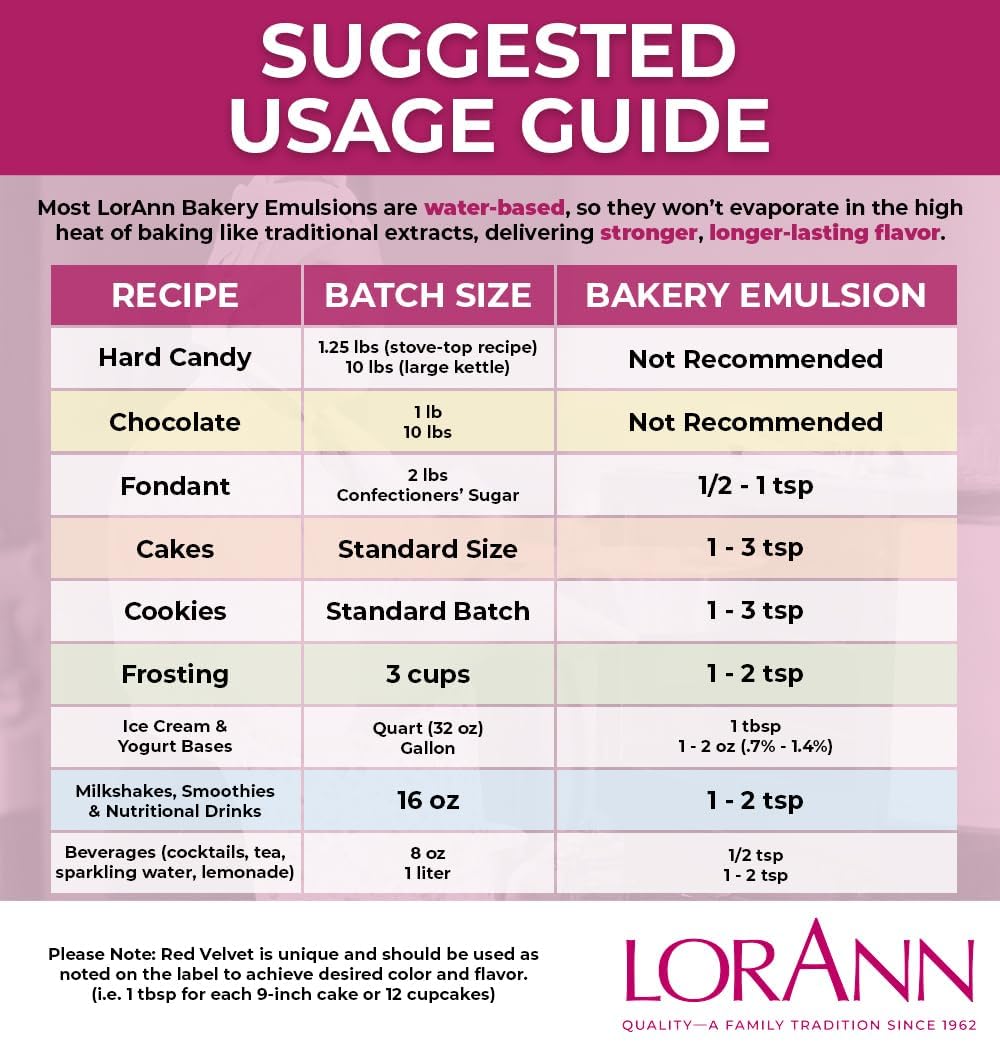
If you’ve ever wondered why certain bakery-bought cakes taste almost more vanilla than real vanilla — brighter, rounder, with none of that faint alcohol edge — the answer is often a bakery emulsion. An emulsion, in baking terms, is a flavoring where tiny droplets of flavor concentrate are suspended in water, held stable by an emulsifier (usually a food-safe gum or lecithin). Unlike a traditional extract, which carries its flavor compounds dissolved in alcohol, an emulsion carries them in water. That matters in the oven: alcohol volatilizes (evaporates quickly when heated), which can mute flavor by the time the cake is done. Water-based emulsions hold on. LorAnn Bakery Emulsions are among the most widely used water-based flavoring systems in American home and small-commercial baking — available in dozens of flavors from vanilla and almond to red velvet and cheesecake. If you’re deciding whether they belong in your pantry or production line alongside your pure extracts and pastes, this guide gives you the full picture.
What Makes LorAnn Emulsions Different from Extract (and When That Difference Pays Off)
The core technical distinction is the carrier: alcohol vs. water. As Serious Eats notes in their overview of vanilla extract science, alcohol is an efficient flavor solvent and preservative, but it also means some volatile aroma compounds leave the baked good during a long bake. Fine Cooking’s examination of flavor carriers in baking reinforces this point — water-based systems can maintain higher apparent flavor intensity in finished baked goods precisely because water doesn’t flash off at the same rate.
For a practitioner, that translates into two concrete advantages:
1. Flavor persistence through high-heat or long-bake applications. Layer cakes, dense quick breads, pound cakes, and any item that spends 45+ minutes in a hot oven will show the biggest gains. Reviewers who use LorAnn almond emulsion in wedding cakes consistently describe the finished product as having a cleaner, more present almond note than the same formula built with alcohol-based almond extract.
2. No alcohol flavor contribution at all. In applications where you’re using a lot of flavoring — think a deeply vanilla-forward chiffon or a white birthday cake where vanilla is the point — alcohol extract at sufficient dosage can introduce a faint sharpness. The emulsion eliminates that variable.
Where extract still wins: in no-bake, cold, or delicate applications where alcohol’s rapid dispersion actually helps bloom the flavor quickly — think a crème anglaise whisked off the heat, or a raw cheesecake filling. King Arthur Baking’s vanilla comparison guide notes that pure vanilla extract’s aromatic complexity (especially from a Bourbon-type or Tahitian source) is difficult to replicate in a water-based system at scale. LorAnn’s vanilla emulsion is excellent for its format, but it’s a different flavor experience than a Heilala or Nielsen-Massey pure extract — more straightforward and “bakery-clean” than complex.
The honest tradeoff table:
| Factor | LorAnn Emulsion | Pure Alcohol Extract |
|---|---|---|
| Heat stability | High — flavor survives long bakes | Moderate — some volatilization |
| Flavor complexity | Good but more linear | Higher ceiling (especially premium single-origin) |
| Alcohol taste contribution | None | Present at high doses |
| Price per application | Lower (concentrated; less per use) | Varies widely by brand tier |
| Cold/no-bake performance | Good | Excellent |
The Potency Problem: Why “A Little Goes a Long Way” Is an Understatement
The single most common theme in aggregated LorAnn reviews is potency surprise. Multiple buyers across review platforms describe the same arc: they substitute one-for-one against extract, and the result is overwhelming. One reviewer’s phrase — “from yum to perfume” — is the most vivid description of over-flavoring in baking writing, and it captures exactly what happens when an emulsion is overdosed. The flavor doesn’t just intensify; it crosses into artificial-smelling territory where no amount of other ingredients can compensate.
This happens for two reasons. First, LorAnn emulsions are formulated at higher flavor concentration than most standard-strength pure extracts. Second, water-based flavoring distributes differently through batter — more evenly, without the brief flash of alcohol that can modulate the initial sensory hit.
The dosing math that matters:
- Standard substitution ratio: 1 teaspoon emulsion = 1 teaspoon extract is the manufacturer’s starting guideline
- But for highly sensitive applications (delicate chiffons, pastry cream, buttercream), many experienced bakers report pulling back to ¾ tsp emulsion per 1 tsp called-for extract
- In high-fat, high-sugar formats (dense frostings, ganache, fondant), full 1:1 or even slightly under ¾ is often right because fat and sugar suppress perceived intensity
- Start at the low end of any range; you can layer more flavor with an additional tiny dose, but you cannot un-perfume an over-flavored cake
Per The Kitchn’s overview of bakery emulsions, the safe working practice is to treat your first use of any new LorAnn flavor as a calibration bake — make a small test batch before committing to a full production run or a high-stakes celebration cake.
Flavor-by-Flavor Breakdown: Where Each Emulsion Earns Its Spot
Vanilla Emulsion — The workhorse. Produces the clean, classic American bakery vanilla note that many consumers associate with “proper” birthday cake. Performs exceptionally in buttercream, where extract sometimes fades after the frosting sits for 24 hours in the refrigerator. Reviewers who’ve compared it directly against butter extract in frosting applications often prefer the vanilla emulsion’s rounder finish.
Almond Emulsion — The standout. Reviewer accounts of using it in wedding cakes are consistent: the almond note is present, sweet, and smooth — closer to the French orgeat register than the sharper, almost medicinal quality that bitter almond extract delivers in high doses. One reviewer’s account of family members specifically preferring the emulsion cake over a version made without it speaks to how the format softens the flavor’s harder edges. Note: this is sweet almond emulsion, not bitter — it behaves completely differently from LorAnn’s super-strength bitter almond oil, which is a different product category and requires dramatically different handling.
Lemon and Orange Emulsions — Strong performers in applications where citrus zest would normally do the heavy lifting. At least one reviewer reports that orange emulsion in a fruit salad was, in their words, indistinguishable from fresh orange zest — a claim worth qualifying (fresh zest carries volatile top notes that no emulsion fully replicates) but that speaks to how effective these emulsions can be in cooked or mixed applications where those volatiles would disappear anyway. In a lemon pound cake or orange-flavored biscotti, the emulsion competes seriously with zest-plus-extract combos.
Cheesecake, Butter, and “Bakery” Emulsions — These are the secret-weapon flavor boosters that serious bakers use not to replace a primary flavor but to round it. Adding a small amount of butter emulsion to a vanilla pound cake introduces the caramelized dairy note that homemade bakes sometimes lack. The cheesecake emulsion in a no-bake cheesecake filling adds a sharp, cream-cheese-forward note that cream cheese alone can’t always achieve consistently.
Pumpkin Spice and Seasonal Flavors — Reviewers note creative use well outside baking: protein shakes, flavored syrups for sparkling water, candy apples (where the emulsion’s water base is compatible with the sugar coating in a way oil-based flavorings can be tricky to use). For candy apple applications specifically, the emulsion format is a practical win — see more on this in the FAQ section below.
The Variety Pack Decision: Smart Sampling Before You Scale
For any baker who hasn’t worked with a specific flavor before — or who is evaluating whether emulsions belong in their workflow at all — the LorAnn variety pack format is the cleanest path to a confident decision. Committing to a larger bottle of a single flavor before you’ve calibrated your dosing to that specific flavor in your specific recipes is a real risk, as the potency comments above make clear. The variety pack gives you calibration samples across multiple flavors without inventory risk.
The upgrade math is straightforward: once you’ve confirmed a flavor works in your top three applications and you’re buying it more than once a quarter, moving to the larger bottle is almost always the better cost-per-ounce decision. For small-batch bakery operators or anyone running a production volume where a single flavor shows up weekly, bulk sourcing becomes relevant — and at that point the per-ounce economics favor larger sizes meaningfully over repeated small-bottle purchases.
Frequently Asked Questions
1. How much LorAnn bakery emulsion do I substitute for vanilla extract in a recipe? Start at a 1:1 ratio — one teaspoon of emulsion for every teaspoon of extract the recipe calls for. In practice, many bakers find that pulling back to about ¾ of the called-for amount works better, especially on a first use with a new flavor. Because emulsions don’t flash off alcohol during baking the way extract does, the perceived intensity in the finished product is often higher than you’d expect from the same volume.
2. Can I use bakery emulsions in candy-making, or do I need the oil-based super-strength versions? It depends on the candy. For candy apples, hard candy coatings applied at moderate temperatures, or chocolate-dipped items where the emulsion is mixed into a coating rather than a sugar syrup, reviewers report success with the water-based emulsions. For high-temperature sugar work — pulled sugar, spun sugar, traditional hard candy cooked above 300°F — you need LorAnn’s oil-based super-strength flavors, not the bakery emulsions. The water in the emulsion can cause the sugar to seize or crystallize at those temperatures. The product lines are distinct; check which format is specified for your application.
3. Why does my emulsion-flavored baked good taste too strong or perfume-like? You’ve overdosed. The “from yum to perfume” threshold is real, and it happens fast with emulsions. Fat and sugar in your formula suppress some of that intensity, so a dense buttercream tolerates more emulsion than a light chiffon batter would. The fix for next time: measure precisely (don’t pour from the bottle into the mixing bowl), start at 75% of the called-for volume, and do a small test batch before scaling a new formula.
4. Do LorAnn emulsions work in cold drinks or only in baked goods? They work in cold applications, though with some caveats. Reviewers report using them in protein shakes and flavored sparkling water. Because they’re water-based, they incorporate more easily into cold beverages than oil-based flavorings, which tend to bead up unless you’re working with an emulsifying base. That said, the flavor profile in a cold, uncooked liquid will be more literal and less rounded than in a baked good — the heat of baking actually mellows some of the sharper flavor edges in any concentrated flavoring.
5. Which LorAnn flavor is best for buttercream frosting that holds flavor after sitting? Vanilla emulsion is the most consistent performer for this application, and it’s specifically what makes many bakery-style buttercreams hold their flavor profile 24–48 hours after application. Emulsion-based vanilla doesn’t lose intensity the way alcohol extract does when the frosting sits in the refrigerator — the alcohol that carries flavor in a standard extract continues to volatilize even after baking, especially in an open frosting surface. Almond emulsion in buttercream is a close second for holding power and is particularly popular in wedding cake contexts.
6. Should I buy the variety pack first, or go straight to a large single-flavor bottle? Buy the variety pack first, full stop — unless you have direct experience with that specific flavor in your specific recipe and format. The dosing calibration alone makes the variety pack worthwhile; the small bottle size lets you experiment without the cost pressure of a larger bottle sitting in inventory. Once you’ve dialed in a flavor and you’re confident it works in your formula, upgrade to the larger size. For professional or semi-professional operators running a flavor regularly in production, the math on the larger bottle is clear — but only after the calibration step.