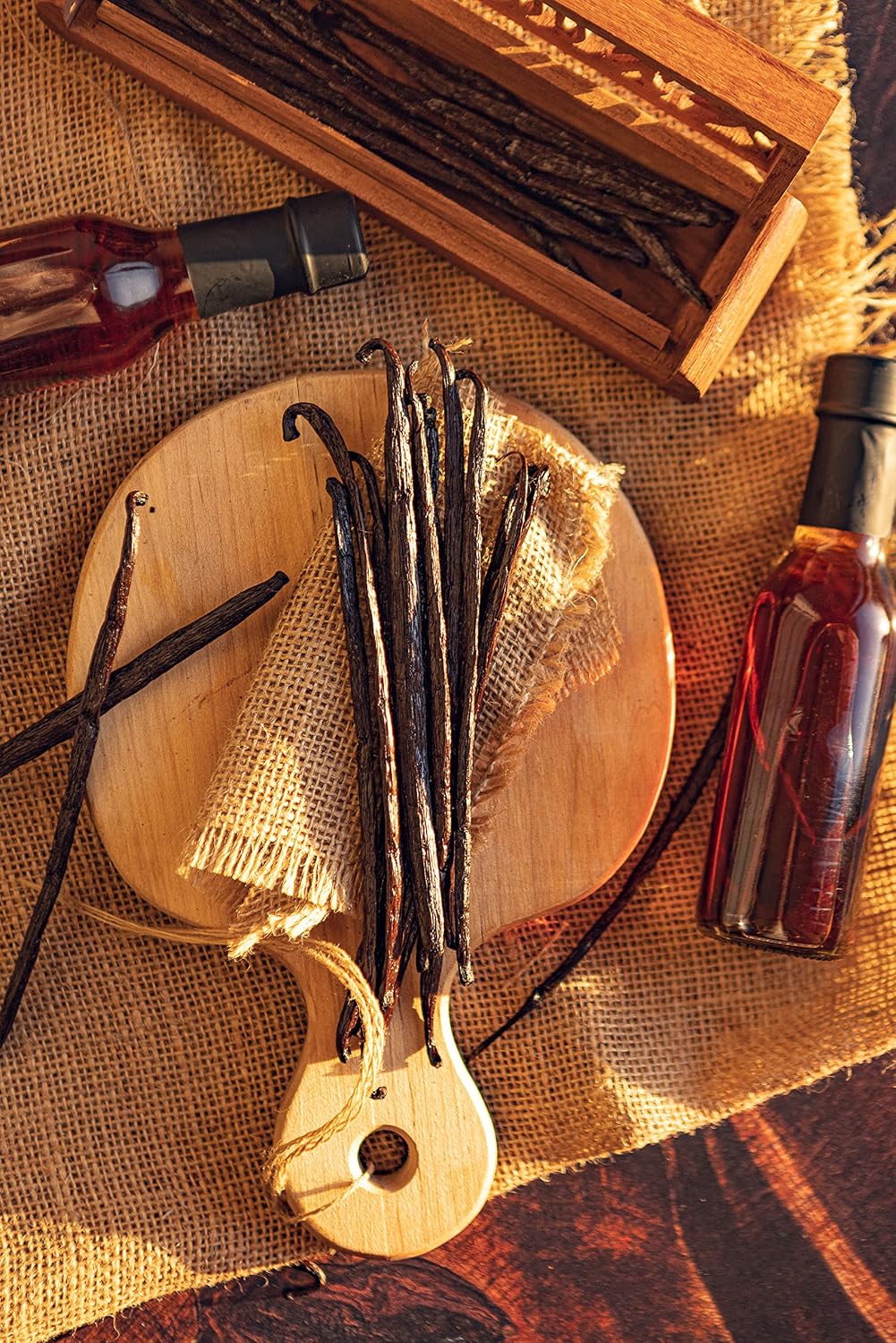
If you’ve ever stood in front of a vanilla bean listing online and wondered what “Grade A” and “Grade B” actually mean—and whether the difference matters when you’re making your own extract at home—you’re in good company. Vanilla extract is simply vanilla beans steeped in an alcohol base long enough for the flavor compounds (primarily one called vanillin, along with hundreds of aromatic partners) to dissolve out of the bean and into the liquid. The grade label on the bean is supposed to tell you something about quality. But here’s the tension: the conventional wisdom says Grade B beans, sometimes sold as “extraction grade,” make superior homemade extract. Reviewers who’ve actually made extract with both grades consistently complicate that story. This article breaks down what the grades mean, where the conventional wisdom holds, and where it quietly falls apart—so you can make a smarter buying decision before your next batch.
| EDITOR'S PICK50 Organic Madagascar Vanilla B… | Mid-tier25 Organic Madagascar Whole Gra… | Budget pick26 Organic Madagascar Vanilla B… | |
|---|---|---|---|
| Bean count | 50 | 25 | 26 |
| Grade | Grade A | Grade A | Grade B |
| Bean length | — | — | 4.5"–5.5" |
| Organic | Organic | Organic | USDA Organic |
| Non-GMO | — | — | ✓ |
| Price | $39.99 | $27.99 | $17.98 |
| See on Amazon → | See on Amazon → | See on Amazon → |
What “Grade A” and “Grade B” Actually Mean
Vanilla beans are typically graded on moisture content and physical appearance. Grade A beans (sometimes called “gourmet” or “prime”) are the plump, supple, visually attractive beans you’d split and scrape for a crème brûlée or a birthday cake. They have higher moisture content—generally 30–35% water by weight—which gives them that characteristic pliability and rich, oily surface.
Grade B beans (labeled “extraction grade” by many sellers) are drier, often thinner, and sometimes slightly split or cosmetically imperfect. Their lower moisture content—roughly 15–25%—means that pound for pound, there’s more dry bean matter and, theoretically, more concentrated flavor compounds relative to water weight.
The logic behind the Grade B extraction argument follows from this: less water in the bean means a higher ratio of vanillin and aromatic oils to moisture, which should translate to a more flavor-dense extract when you steep. Fine Cooking’s overview of working with vanilla notes that extraction-grade beans were historically developed specifically for industrial extract production, where that concentrated dry matter genuinely matters at scale.
But here’s what the grading system doesn’t tell you: moisture content is only one variable. The origin, curing method, post-harvest handling, and age of the bean at the time you purchase it shape the flavor profile at least as much as the moisture grade. King Arthur Baking Company’s guide to homemade vanilla extract points this out directly—the quality of your starting bean, not just its grade designation, is what ends up in your bottle.
The Real Quality Signal Reviewers Actually Use
If you read through accumulated buyer reviews on vanilla bean listings—across Grade A and Grade B products alike—a clear pattern emerges. Reviewers almost never cite the grade letter as their primary quality indicator. What they describe, over and over, is physical texture: plump, moist, and not brittle are the words that appear with striking consistency as proxies for a good bean.
This is important because it cuts across the grade divide. A poorly stored Grade B bean that arrives dry, crumbly, and without fragrance will underperform a fresh, supple Grade A bean that’s been handled well. Conversely, a genuinely high-quality Grade B bean from a trusted source—dense with aromatic oils, flexible despite its lower moisture—will perform exactly as the extraction-grade marketing promises.
The Kitchn’s explainer on vanilla bean forms confirms this framing: freshness and handling matter enormously, and a bean that snaps when you try to bend it has already lost a meaningful portion of its volatile aromatics. Those are the compounds that make your extract smell and taste like vanilla rather than flat sweetness.
The practical takeaway: When evaluating a Grade B bean listing, don’t anchor on the grade designation. Ask whether the seller’s reviews describe beans as oily, pliable, and fragrant on arrival. That’s the signal that travels across grades.
The Spirit Matters More Than Most Bakers Expect
One of the most concrete data points available from long-term home extract makers comes from a reviewer who documented four consecutive years of homemade extract production, rotating spirits each year: vodka, then brandy, then rum, then back to compare. Their consistent finding: brandy and rum produced noticeably superior aroma to vodka, with the extract coming out richer, more complex, and more rounded in finished baked goods.
This lines up with what Serious Eats has observed in their vanilla extract coverage: a neutral spirit like vodka lets the vanilla bean speak clearly, but spirits with their own flavor compounds—the congeners and esters in rum and brandy—contribute complementary aromatic layers that vodka simply can’t. The vanilla doesn’t get buried; it gets amplified by a more sympathetic solvent.
For practical extract-making decisions, this means:
- Vodka is the baseline. It’s the most predictable and the easiest to find at consistent proof (80 proof / 40% ABV is the standard). Good for your first batch or when you want pure vanilla character with no interference.
- Rum (dark or aged) adds warmth and depth. Reviewers who use rum frequently describe the resulting extract as “rounder” in desserts where caramel or brown butter notes are already present.
- Brandy tilts fruity and floral. One reviewer who steeped half a 26-bean Grade B pack directly in a bottle of bourbon whiskey—recapping it and storing for eight weeks—reported an extract with striking depth and a distinct warm-spice character that worked particularly well in spiced holiday baked goods.
- Bourbon whiskey is worth noting as an outlier approach: it’s not a neutral spirit and the oak and vanilla notes already present in the whiskey create a synergistic effect with the beans. If you want a more complex extract with savory-sweet depth, this approach has a real following among home bakers making extract specifically for holiday gift sets.
By the numbers — spirit proof and extraction efficiency:
| Spirit | Typical ABV | Extraction Rate | Flavor Contribution |
|---|---|---|---|
| Vodka (80 proof) | 40% | Standard baseline | Neutral — pure vanilla forward |
| Dark Rum | 40–45% | Comparable to vodka | Adds warmth, molasses complexity |
| Brandy/Cognac | 40% | Comparable | Adds fruity, floral lift |
| Bourbon Whiskey | 40–45% | Comparable | Oak, vanilla, spice overlay |
The FDA standard of identity for pure vanilla extract requires a minimum of 35% ABV solvent, which all of the above clear comfortably.
Origin Matters: Tahitian vs. Madagascar Beans in Homemade Extract
If you’re only comparing Grade A to Grade B within a single origin, you’re missing one of the bigger flavor decisions available to you: which species of vanilla bean you choose.
The vast majority of vanilla beans sold for home extraction are Planifolia beans from Madagascar (often called Bourbon-type, after the historical name for Réunion island). These produce the classic vanilla profile most bakers recognize: rich, creamy, slightly woody, with deep vanillin character.
Tahitian beans (Vanilla tahitensis) are a different species entirely, and buyers who switch to them for extract making describe a noticeably different sensory experience. Tahitian beans are naturally higher in a compound called heliotropin (piperonal), which gives them a more floral, cherry-like, anise-adjacent quality. Reviewers consistently use words like “floral,” “fruity,” and “perfumed” to describe Tahitian extract, while Madagascar extract reads as “warm,” “creamy,” and “rich.”
For extract-making purposes, Tahitian beans are worth knowing about if:
- You’re making extract for white chocolate ganache, panna cotta, or light fruit-forward desserts where the floral note can perform rather than get buried
- You want to make a blended extract (Tahitian + Madagascar beans in the same bottle) for complexity
- You’re making extract as a gift and want to offer a flavor the recipient likely hasn’t encountered before
Fine Cooking’s vanilla working guide notes that Tahitian beans are generally lower in total vanillin than Madagascar beans—so if raw vanillin output is your benchmark for extract strength, Madagascar wins on that metric. But if flavor complexity is the goal, Tahitian beans bring a dimension that Madagascar cannot replicate.
The Gift-Batch Timeline Problem (And How to Plan Around It)
A recurring theme among reviewers making vanilla extract as holiday gifts: they almost always wish they started sooner. The minimum steeping time before homemade extract is genuinely usable is around eight weeks at room temperature. But most experienced extract makers report the extract continues developing for four to six months, and some describe keeping beans in the bottle for a year or more, topping off with fresh spirit as needed.
If you’re planning holiday gift batches—a genuinely popular use case, given that a bottle of homemade vanilla extract with a handwritten label is both personal and useful—the planning math looks like this:
- December gifting: Start no later than mid-September for a minimally ready product; start in June or July if you want something genuinely impressive.
- Summer gifting: Start in January or February.
- A 26-bean Grade B pack steeped in a full 750ml bottle of spirit (roughly one to two beans per ounce of spirit, depending on desired strength) gives you a substantial batch. Many reviewers who make gifts split this into multiple four-ounce bottles with two to three beans visible in each bottle—both for aesthetics and so the recipient can continue the extraction.
The reuse question is real and practical: yes, you can reuse vanilla beans after a first extraction batch. Most reviewers top off their bottle with fresh spirit rather than starting over. The beans continue contributing flavor, though with diminishing intensity over successive batches. When the extract from a refilled bottle lacks aroma after a long steep, the beans have given what they have.
Frequently Asked Questions
Do Grade B beans really make better extract than Grade A, or is that a myth?
It’s more myth than settled fact. The underlying logic—that drier beans have higher vanillin density per pound—is real, but in practice, reviewers report equally excellent extract from Grade A beans. The deciding factor is bean freshness and quality at the time of purchase, not the grade label. “Plump, moist, and not brittle” is the quality signal that matters regardless of grade.
How many vanilla beans do I need to fill a standard mason jar or vodka bottle?
The FDA standard for pure vanilla extract is 13.35 ounces of vanilla beans per gallon of 35% ABV spirit—which works out to roughly one to two beans per ounce of liquid for home batches. For an eight-ounce mason jar, aim for 8–10 beans as a starting point. For a standard 750ml (25oz) spirit bottle, 20–26 beans is the common reviewer range for a robust extract.
What is the minimum steeping time before homemade extract is usable?
Eight weeks at room temperature, in a dark location, is the generally accepted minimum. The extract will have vanilla color and detectable flavor by then. Most reviewers note significant improvement between the eight-week and six-month marks, with the flavor becoming rounder and more complex over time.
Can I reuse vanilla beans after the first extraction batch?
Yes. The standard practice is to top off the bottle with fresh spirit rather than discard the spent beans. The beans will continue contributing flavor over successive refills, with gradually diminishing output. Many reviewers report using the same beans for 12–18 months before flavor contribution becomes negligible.
How do Tahitian vanilla beans change the flavor profile of homemade extract compared to Madagascar beans?
Significantly. Madagascar extract reads as warm, creamy, and rich—the “classic” vanilla profile. Tahitian extract runs floral, fruity, and slightly cherry-anise in character due to higher heliotropin content. Tahitian extract tends to shine in delicate, light-colored desserts and white chocolate applications. Madagascar is the stronger performer in bold, warm-spiced, or brown-butter-forward baking where its deep vanillin character can anchor the flavor.
The Decision Frame: If X, Then Y
Here’s how to apply all of this to your next purchase decision:
- If you want maximum vanillin output per dollar spent: Grade B from a seller with reviews describing fresh, oily, pliable beans. Steep in 80-proof vodka for the cleanest extraction.
- If you want the best overall extract with no tradeoffs on bean quality: Grade A from a trusted source. Steep in dark rum or brandy. Expect results that reviewers consistently rate as excellent—the grade B advantage is real but modest with quality sourcing.
- If you’re making holiday gifts and want a memorable, distinctive product: Tahitian Grade A or B beans, steeped in brandy or aged rum, started at least four months in advance.
- If you want the most complex, warm-spiced extract for personal use in fall and winter baking: Follow the documented reviewer approach—steep 13 Grade B beans in a recapped bottle of bourbon whiskey for eight weeks minimum. The synergy between the spirit’s existing vanilla-oak notes and the beans produces something noticeably different from vodka-based extract.
The grade label is a starting point, not a verdict. Let bean condition and your spirit choice do the actual work.